 https://orcid.org/0000-0001-7256-8226
Introduction
The last few decades have brought a boom in statistical research on ethnolinguistic vitality, developed initially from a social psychological perspective (Bourhis et al., 2019) and focusing on the survival of migrant groups in a new country of settlement. The classic definition states that “the vitality of an ethnolinguistic group is that which makes a group likely to behave as a distinctive and active entity in intergroup situations” (Giles et al., 1977, p. 308) and was based on three objective criteria: status, demography, and institutional support. This concept was quickly enriched to include subjective factors of ELV (Bourhis et al., 1981), taking into account how groups may cognitively and affectively perceive the same factors (Smith et al., 2017). However, from a socio-psychological perspective, the strength of ELV has only been measured through questionnaire studies and has provided quantifiable, numerical results.
Such an approach was strongly criticized by sociolinguists who pointed out its limitations. They argued for a nuanced interdisciplinary approach that included both qualitative and quantitative data, and emphasized the importance of community engagement and a broader view of community-based language development (see Bucholtz & Hall, 2008; Hinton, 2001; Lewis & Simons, 2013). This view was rooted in the perspective of language ecology: a reflection on how languages interact with each other, where they are used and how they relate to each other (Haugen, 1972). From the outset, the language ecology approach was linked to the concept of the need to preserve linguistic diversity.
The necessity to take into account a wide range of factors influencing the vitality of languages (and their communities), and the need to systematize degrees of language endangerment, led to the emergence of language vitality/endangerment scales in sociolinguistic research. The eight-point Graded Intergenerational Disruption Scale (GIDS) proposed by Joshua Fishman determined the degree of language endangerment (Fishman, 1991). At the same time, each degree corresponded to a possible action to reverse the language shift. Intergenerational transmission of the language and its use in the home-neighbourhood-community environment was placed at the centre of the scale as the most important factor in language preservation. Determining the degree of endangerment was made possible by qualitative research, instead of quantitative one as in classical ELV studies, and the research itself was geared towards practical application (Fishman, 2001).
In 2003, UNESCO’s “Language Vitality and Endangerment” (UNESCO, 2003) proposed a new assessment of language endangerment and documentation needs: the Language Vitality Index. The key factors affecting language vitality were both objective (intergenerational transmission, absolute number of speakers, availability of materials for language education and literacy, status, government support) and subjective (community and government attitudes towards the language). The caveat is that these factors should not be considered in isolation, as a language ranking high on one factor may require substantial action on another. Six levels of endangerment have been identified for each factor, from safe to extinct.
In a further step, Fishman’s scale was extended by Lewis and Simons (2010). Their Expanded GIDS was used to assess the situation of a language in terms of threat and/or development. This scale has 12 levels corresponding to the degree of threat, and once again determined the vitality of languages in a linear way, based primarily on the extent and areas of language use and active speaker demographics.
The quantitative research was revisited among others by researchers from the European Language Diversity for All (ELDIA) project, conducted between 2010 and 2013 in twelve multilingual communities. This research looked only at language vitality, leaving aside the identity dimensions of the language community. As part of the research, a European Language Vitality Barometer (EuLaViBar) questionnaire was created, with questions considering practices and attitudes in four areas: legislation, education, media, and language practices. On the basis of this information, the strength of a group’s language vitality was calculated in four areas: capacity, opportunity, desire, and language products. The influence of group cohesion and identity on vitality was completely overlooked. The results of the research were presented as a multicoloured graph, demonstrating the ambiguity of the phenomenon of vitality.
Meanwhile, in parallel with the concept of linguistic vitality and the scales and models that express it, sociolinguistic research into minority communities and endangered languages has developed. It has been pointed out that language exists only through the people who use it (Irvine & Gal, 2000), although the relationship of language and identity can have very different levels (from active use to a symbolic relationship, see Edwards, 2009). Different types of speakers of minority languages undergoing revitalisation efforts have been observed, and it has been noted that anyone can become a speaker – not only those born as members of a minority community, but also newcomers to the region who decided to learn the language, or those from linguistically assimilated families who want to give their children a chance to learn the language at school (Grinevald & Bert, 2011) – hence the creation of new categories of speakers (especially new speakers), and the study of their role in language revitalisation, as well as the tensions between them and traditional speakers governed by a range of language ideologies (O’Rourke et al., 2015). Research on the impact of language ideologies on all categories of speakers and their willingness/ability to use a minority language in different situations has provided an understanding of how power relations and unequal social mechanisms manifest themselves in language and constrain language use (Smith-Christmas et al., 2018). Alongside research on language ideologies, research on attitudes towards languages has flourished (Kircher & Zipp, 2022), showing that language use in different domains is not solely a function of linguistic competence, but an interplay of many factors conditioning people’s linguistic behaviour. The impact of negative experiences – language discrimination and trauma – both on individuals’ mental health and wellbeing and on their attitudes towards the language has also been studied (McKenzie, 2022). It has also been shown that economic and social benefits can enhance the revitalisation process (Olko, 2021). The above studies represent only part of the output of contemporary sociolinguistics, revealing the need to present ELV in all its complexity.
The research challenge we set ourselves was to combine quantitative and qualitative research and to create a model taking into account the achievements of contemporary critical sociolinguistics, reflecting the multidimensionality of the ELV phenomenon. At the same time, we assumed that it is not possible to clearly measure the degree of ELV, as the factors influencing it may have different meanings (strengthening or weakening it) depending on the context in which the language community functions. For example, the inclusive or exclusive nature of a group may, in one case, be an important strategy for preserving the language and group cohesion, while in another case (e.g. when the demographic situation of the region changes) this may be counterproductive (on this problem in relation to Upper Lusatia, see Dołowy-Rybińska, 2023). For this reason, our approach is always to analyse the results of quantitative research in the sociopolitical context of minority/majority relations and to contrast them with qualitative research.
The social psychology approach focuses primarily on intergroup relations and sees the group as an ethnically and institutionally bound entity, whose language – and the degree to which it is preserved – is a manifestation of vitality. Research within the linguistic ecology paradigm focuses on intergenerational transmission, supported by minority institutions that enable the language to be used in different domains. At the same time, however, they assess the degree of vitality in a linear, one-dimensional way. Such a simplistic picture of ELV does not, in our view, allow us to fully understand the situation of minorities and their languages and to respond to the changing conditions in which communities operate.
Model of ethnolinguistic vitality
We propose an original model of ELV based on a sociolinguistic research approach and using psychometric methodology. We understand ethnolinguistic vitality as a dynamic system of mutually influential factors that condition a group to perceive itself and be perceived as a distinct entity with a common identity and language. It is a multidimensional phenomenon that includes various subjective factors that have been identified on the basis of sociolinguistic research. The research was based on an original Ethnolinguistic Vitality Questionnaire. Following a pilot study involving cognitive interviews that helped refine the questions and ensure their alignment with the intended theoretical constructs, the final version of the questionnaire was distributed in printed form across five regions between mid-2022 and September 2023. The reliability and construct validity of the questionnaire were later assessed through analyses of question dependencies, correlations with objective indicators, and qualitative field observations. The main methodological challenge was to achieve representativeness, given that the collateral language communities under study were dispersed and lacked clear administrative boundaries, making it impossible to sample them using standard random methods. To address this issue, two complementary sampling approaches were employed. First, freely-distributed questionnaires were considered. These were distributed during fieldwork among people from different parts of the region. To avoid overrepresentation of respondents engaged in language- and culture-related activities, a question was added to the questionnaire to determine the level and type of their involvement. Some of the questionnaires were also distributed by project collaborators in the field. However, we tried to avoid collecting too many questionnaires in any one place. The second method involved conducting reference surveys in selected villages that were chosen on the basis of their central location, typical sociodemographic structures, and distance from language activist initiatives. Data from both methods were merged into a single, unweighted dataset. Comparisons between the two samples suggested that combining them improved inclusiveness and reduced the risk of excluding certain respondent groups. While this approach does not guarantee full representativeness, it was deemed the most suitable for comparative regional analysis, enhancing the dataset's internal diversity (see Dołowy-Rybińska & Mętrak, 2022, and Dołowy & Mętrak, 2026, for more information). A total of 420 questionnaires were collected in Silesia, 389 in Kashubia, 322 in Podlachia, 246 in Podhale, and 208 in Masuria.
Based on the 61-question Ethnolinguistic Vitality Questionnaire we identified two observable variables of ELV that we consider to be the most important for linguistic vitality within communities (intergenerational transmission of the language and language competences), as well as 11 latent variables constructed using a psychometric approach. These 11 variables were created based on theoretical sociolinguistic considerations regarding language maintenance and revitalization. Of the many ideas we considered, these 11 have been proven empirically through statistical calculations. The ELV features are classified into four basic categories:
Linguistic features related to language and communication skills, such as intergenerational transmission and language competence, as well as how these skills are used in language practices.
Identity features, including the degree of identification with other individuals in the group, the sense of distinctiveness from the dominant group (collective identity), and the role of language in unifying individuals within the community (identity and language). This also includes the features on which the community builds its distinctiveness, such as its attitude towards outsiders as potential community members and legitimate speakers of the language (type of identity, ideology of language ownership).
Language ideologies related to language status, which are particularly important in the case of collateral and contested languages. This includes how people perceive them, the role and protection they attribute to them (ideology of collaterality), and the contexts considered appropriate to use them (subordination/affirmation).
Language attitudes that impact language use, including emotions related to language use and other aspects that influence people’s willingness to use the language and openly identify with the group (reluctance to use language in public), such as negative experiences and profits of language use.
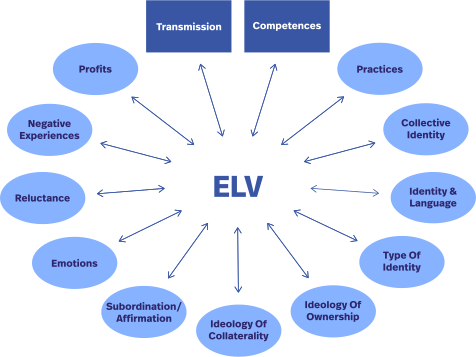
Two variables (Intergenerational Transmission and Language Competences) are enclosed within a rectangular frame to indicate observable variables, which are measured as a percentage of responses. The remaining 11 variables are enclosed in oval frames, which indicate their latent nature. The ELV model presented takes into account several variables that interact with each other and with the notion of ELV of the group as a whole. We extracted the following latent variables (all explained in details in Dołowy & Mętrak, 2026):
Language Practices refer to who speaks the language with whom, where, and how often. They provide a pattern for everyday language use and its use in other situations (see Fishman, 1991).
Collective Identity shows the belief of individuals that they form a common group with others, and that they are different from another group (in this case the dominant one). In the case of minority groups, such relations always involve relations of power (see Clément & Norton, 2021).
Identity and Language tells us about the role of language in defining the collective identity (as a symbol of it, an element of differentiation from other groups, or as a means of communication) (see Edwards, 2009).
Type of Identity defines the extent to which a group’s identity is inclusive (i.e. open to people with no primordial connection to the group) and the extent to which it is exclusive (i.e. intended only for people who meet certain criteria of origin) (see Kataria, 2018).
Ideology of Language Ownership is the belief that a particular group of people ‘owns’ the language and has a better right to use it than people from outside of the group; this group becomes ‘guardians’ of that language, only granting access to it to those who are ‘entitled’ by origin and innate group membership (see Sallabank & Marquis, 2018).
Ideology of Collaterality is the latent variable most strongly associated with the characteristics of the groups and languages studied within the project. It relates to the perception of a group, its language and its status, as well as the perceived need for state protection, development of written forms and teaching in schools (see Dołowy et al., 2026).
Subordination/Affirmation is an ideology of the perceived appropriateness of the use of collateral language in different domains and spheres (from private to public places). Subordination is linked to power relations and manifests itself in two basic ideologies. The first is the rule of politeness – the belief that it is inappropriate to use the minority language among people who do not speak it (Trosset, 1986). The second is the linguistic subordination norm, which treats the languages of subordinate groups and their use as a deficit rather than equal to the dominant language (Hornsby, 2011). Affirmation is an attitude of perceiving the use of the language as appropriate.
Emotions that accompany speaking a collateral language reflect both the attachment to the language and the attitudes towards it (pride and shame), as well as the psychological reactions associated with its use (Frenzel & Stephens, 2013).
Reluctance to Use Language in Public shows attitudes towards the use of the language in a situation where it can easily identify the speaker as a member of a minority (language) community. This reflects people’s feelings and fears caused by being a speaker of a minority language, and is related to the categorisation of where the language could be used and where it should not be (Dewaele & van Oudenhoven, 2009).
Negative Experiences (related to the use of a language) refer to difficult experiences of language use outside the home and community, or the direct or indirect prohibition of language use. These are mainly situations of domination and power: parents, school, or workplaces (Skutnabb-Kangas & Phillipson, 1994).
Profits (related to the use of a collateral language) is a category that shows the positive experiences of language use on the one hand, and the ‘gratification’ (symbolic or utilitarian) of language use on the other (see Coulmas, 2005).
We do not consider these two observable and 11 latent variables to be the only variables affecting the ELV of communities using minority, regional, or contested languages. In other cases, it may turn out that additional variables will emerge, or that variables which were significant in our model for collateral language communities will lose their validity. Therefore, each ELV study should be based on a questionnaire designed for a specific minority group and the variables identified as relevant to ELV must be verified empirically.
In the model we have created, the system of factors influencing ELV is dynamic and interrelated (hence the arrows pointing in two directions). While specific aspects of ELV determine its strength, the vitality itself interacts with the other variables, strengthening or weakening them. Each of the latent variables in turn depends on the broader sociopolitical context in which the minority group operates. The highlighted latent variables do not have the same meaning for the ELV of communities that use collateral languages. Some become group identifiers, while others perform additional functions that either support or hinder group and language cohesion. Nevertheless, we deliberately refrain from placing these features in any pre-determined hierarchy. Depending on the context and situation of the group, different aspects may have different meanings. For instance, we can envisage a scenario where intergenerational language transmission is declining, and the community possesses minimal linguistic proficiency and limited language usage. However, at the same time, the community has a strong identity and symbolic connection to the language and is open to potential speakers, regardless of their ethnic origin. With low ideology of collaterality and a positive attitude, there is a real chance of language revitalisation, as evidenced by the Manx-speaking community (see Wilson, 2011). Conversely, despite the language still being transmitted up to a crisis moment, we can imagine a group that does not want to use it because it is associated with linguistic trauma or an overt ban. This was the case with Wymysorys in Poland (see Mętrak, 2019). With a strong ideology of collaterality, language preservation can be very challenging. However, as with Wymysorys, changing conditions may impact the community’s will to revitalize their language and reinforce their sense of group identity. Therefore, all characteristics are given equal weighting, and it is only through interpreting them in the particular group’s context and through qualitative research that we can understand which characteristics become the most important in a given system.
Our model allows us to view ELV as a dynamic phenomenon and vitality as a process that changes over time and under the influence of various factors, both external and internal to the group (including language-related activities). The necessary context for the analysis of the data is based on the sociopolitical aspects of ELV, related to the situation of the group and its language (see Table 3 for five communities of collateral languages in Poland). These aspects are:
Demography (the number of people who identify with the group, the number of people who use the language, with a caveat that often – especially for unrecognized groups – such data is not available).
Legal status (of the group and its language).
Minority/majority relationship (the history of the group and its relationship with the dominant community; the relationship of the minority language to the dominant language and changes in its status and social reception over time; the socio-political situation that determines whether and to what extent the group is able and willing to exercise its collective and linguistic rights).
Institutional support (the infrastructure available to the groups, including the support for the process of language standardization).
The significance of various subjective factors becomes comprehensible by setting them in the wider context of objective factors of the past and current sociopolitical situation. From the outset of the study, the research team conducted qualitative research based on ethnographic methods. This included participant and non-participant observations, as well as in-depth interviews with inhabitants of the studied regions. In total, over 300 interviews were recorded, transcribed, and coded using MAXQDA software. The coding process combined inductive (data-driven) and deductive (theory-driven) approaches (Fereday & Muir-Cochrane, 2006) to focus on various aspects of ELV. This qualitative research enabled us to interpret the quantitative data.
Applying psychometrics to measure ethnolinguistic vitality
In the presented approach, we use developments from psychometrics to address the problem of measuring particular aspects of ELV. The main problem psychometrics faces is the measurement of general attitudes based on several observable characteristics (Furr & Bacharach, 2013). The general attitudes we measure are the eleven variables of ELV identified in the previous section. Following the approach used in psychometrics, we assume that more general attitudes are not directly observable but become latent variables. They are empirically manifested in respondents’ answers to individual questionnaire questions, called items or indicators. On the basis of the theoretical assumptions made, we assigned a number of observable variables associated with each latent variable. We then used Item Response Theory analysis techniques to check that the measurement model was correct, and calculated the value of the latent variable for each respondent according to the model obtained.
The latent variables are constructed in such a way that they are represented by continuous (interval) variables, which tend to take values from -3 to 3 among the study participants, with an average close to 0. In addition, the values for each individual under study indicate the strength of the presence of a particular aspect of ELV – the higher the value of the latent variable, the stronger the Collective Identity, the Ideology of Language Ownership, etc. On the other hand, these variables take on abstract values: i.e., for respondents who have been assigned specific values for a latent variable (e.g. -1 or 2), it is not known which specific answers they have given to particular questions of the questionnaire.
However, we can use these variables to compare individuals between respondents or compare the means of a given latent variable across groups of respondents. Comparisons of group means could, in turn, determine whether there are differences between the groups being studied and, if so, in which groups a particular aspect of ELV is stronger and in which groups it is weaker. On the one hand, this allows us to see where different variables of ELV are positioned in relation to different communities and to draw conclusions about their strength in this particular aspect. On the other hand, we can see how these different variables of ELV correlate with each other and draw more general conclusions about the ELV of each community. We will present in detail how latent variables are constructed using the example of one of the latent variables, namely ‘Subordination/Affirmation’.
Measurement of Subordination/Affirmation
In the case of the latent variable Subordination/Affirmation, we used the following empirically observable variables as items associated with this latent variable:
Q39A) Is speaking X [where X is a collateral language] appropriate in a church?
Q39B) Is speaking X appropriate in an office?
Q39C) Is speaking X appropriate in a shop?
Q39D) Is speaking X appropriate at a medical doctor’s?
Q39E) Is speaking X appropriate on television?
Q39F) Is speaking X appropriate at a police station?
Q39G) Is speaking X appropriate during a session of the municipal/city council?
Q39H) Is speaking X appropriate during a session of the regional parliament?
Q39I) Is speaking X appropriate in court?
Q39J) Is speaking X appropriate at school?
Q36) Do you think it is appropriate to speak X among people who do not speak it?
For each of the questions in the Q39A – Q39J battery, respondents gave answers ranging from ‘1 – Definitely not appropriate’ to ‘5 – Definitely appropriate’. For question Q36, respondents answered using a scale ranging from ‘1 – Definitely not’ to ‘5 – Definitely yes’.
Using Item Response Theory (de Ayala, 2009; Sijtsma & Milenaar, 2002; van Schuur, 2011), we empirically tested whether the measurement model is indeed observed in our data. This is a crucial part of our analyses, as this is the stage in which we verify our theoretical expectations. We check whether the empirical data confirms the theoretically-based expectations of the relationship between Subordination/Affirmation and the indicator variables. The measure we use to fit the model to the data is the Root Mean Square Error of Approximation (RMSEA) statistic, calculated for each item. In the literature (Sijtsma & Milenaar, 2002), it is assumed that the value of this statistic should not be greater than 0.1 and ideally should be less than 0.05 to identify the correct model specification. The values of these parameters are shown in (Table 1). All are in the range of 0.04 to 0.05, which means that all indicators are a good fit to the model and our expectation that the indicator variables could be treated as generated by a single latent variable Subordination/Affirmation was confirmed empirically. Our theoretical expectations turned out to fit the data well.
| Item | Item fit – RMSE |
|---|---|
| Q39A. Is speaking X appropriate in a church? | 0.04 |
| Q39B. Is speaking X appropriate in an office? | 0.04 |
| Q39C. Is speaking X appropriate in a shop? | 0.05 |
| Q39D. Is speaking X appropriate at a medical doctor’s? | 0.04 |
| Q39E. Is speaking X appropriate on television? | 0.04 |
| Q39F. Is speaking X appropriate at a police station? | 0.04 |
| Q39G. Is speaking X appropriate during a session of the municipal/city council? | 0.04 |
| Q39H. Is speaking X appropriate during a session of the regional parliament? | 0.04 |
| Q39I. Is speaking X appropriate in court? | 0.05 |
| Q39J. Is speaking X appropriate at school? | 0.04 |
| Q36. Do you think it is appropriate to speak X among people who do not speak it? | 0.05 |
The next step checked the directions of the correlations: the measurement model constructed a latent variable that generated respondents’ answers. The relationship between the observable and latent variables are shown in Figure 2. Each observable variable is shown in a single panel. The horizontal axis on each panel represents the values of the latent variable. The curves presented in the graphs indicate, for a range of values of the latent variable, the probability of a given value of observable variables. Values of observable variables are indicated by various colours.
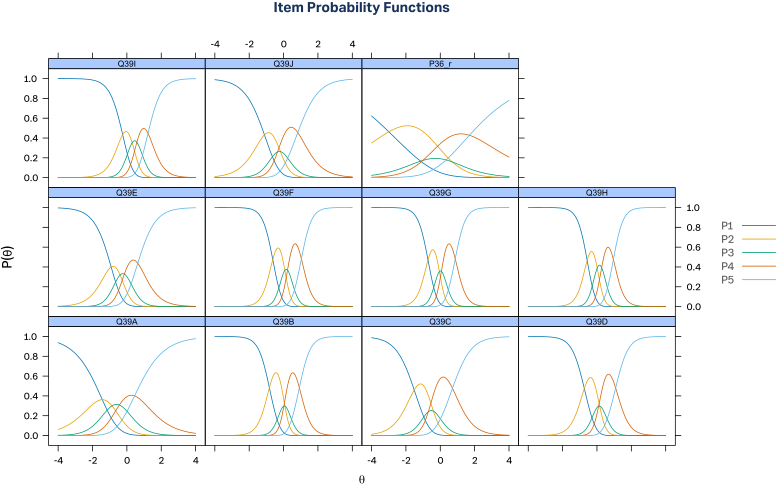
It is important to note that in the case of Subordination/Affirmation, the higher the value of the latent variable, the more strongly the respondents indicated that it was appropriate to use the language in question in the situations listed. Low values of the latent variable indicate subordination, a stronger belief that language should not be used in various public places. In contrast, high values of the latent variable indicate language affirmation, which is the belief that it is appropriate to use the language in all the situations indicated in the questions. The subsequent part of the analyses was to assign each respondent a value for the latent variable Subordination/Affirmation. In the dataset we analysed, this variable takes values ranging from -2.3 to 2.2.
We would like to draw attention to another feature of the measurement we carried out using Item Response Theory. This technique does not require that the indicator variables have the same or similar distributions. An example of this are the variables used as indicators in the Subordination/Affirmation measurement model. The distributions of the values of these variables are shown in Table 2. Here, we can see that in some situations respondents indicated more often that the use of collateral language was appropriate, while in other situations such attitudes were much less frequent. For example, in the case of using collateral language in a shop or church, the percentage of respondents who indicated it was appropriate (somewhat or strongly) was 63% and 58%, respectively. On the other hand, those declaring that the use of collateral language in court or during a session of the provincial assembly was appropriate amounted to 21% in both cases. Despite this discrepancy, the IRT model classified these responses as coming from the same latent variable. This is because the modelling assumes that certain items are easier to agree with and certain items are more difficult to agree with. At the same time, it is assumed that the items occur in a certain hierarchy, such as that those agreeing with the difficult item should also agree with the easy one – in our case, this means that those agreeing that it is appropriate to speak in a collateral language in court or in a session of the provincial assembly should also think it is appropriate to speak the language in a shop or a church. On the other hand, those who agree that it is appropriate to speak in a collateral language in a shop or church do not necessarily think it is appropriate to do so in court or in a session of the provincial assembly.
Is speaking X appropriate in (N=1585) |
Definitely not appropriate | Somewhat not appropriate | Hard to say | Somewhat appropriate | Definitely appropriate |
|---|---|---|---|---|---|
| P39C. … in a shop | 7.9 % | 15.6 % | 13.5 % | 38.5 % | 24.6 % |
| P39A. … in a church | 8.3 % | 13.1 % | 20.3 % | 29.9 % | 28.5 % |
| P39J. … at school | 13.2 % | 20.0 % | 16.6 % | 29.7 % | 20.5 % |
| P39E. … on television | 14.6 % | 16.8 % | 19.6 % | 26.2 % | 22.8 % |
| P39B. … in an office | 18.3 % | 29.0 % | 14.4 % | 22.4 % | 15.8 % |
| P39G. … during the session of municipal council | 20.0 % | 24.4 % | 17.0 % | 22.4 % | 16.3 % |
| P39D. … at a medical doctor’s | 21.0 % | 29.8 % | 14.9 % | 20.7 % | 13.6 % |
| P39F. … at a police station | 23.1 % | 28.3 % | 17.0 % | 18.1 % | 13.5 % |
| P39H. … during a session of regional parliament | 24.3 % | 25.9 % | 18.7 % | 16.8 % | 14.4 % |
| P39I. … in court | 36.3 % | 27.1 % | 15.2 % | 10.7 % | 10.7 % |
In the next section, we will discuss how applicable the model is to collateral language communities in Poland. Firstly, we will introduce the concept of collateral languages and their communities. Secondly, we will describe the context on which the analysis is based. Thirdly, we will analyse the data of one chosen latent variable, namely Subordination/Affirmation, using qualitative research.
ELV of collateral language communities in Poland - application of the model
The concept
Collateral languages are autochthonous varieties linked to a particular territory that, due to their close relationship to the dominant language, are often considered dialects of it (Eloy, 2004). Their users see themselves mainly as ‘regional’ groups and often lack an ethnic or national identity distinct from the dominant one (Wicherkiewicz, 2014). Nevertheless, in recent years important changes have happened in the way that these languages function, including their societal role and the sense of collective identity. This is a result of efforts undertaken to strengthen or revitalize such varieties through standardization, introducing them into new domains of use and granting them the status of languages.
The aim of the “Linguistic Diversity in Poland” project was to investigate the ethnolinguistic vitality of selected collateral language communities. We conducted research in five regions of Poland where collateral languages are spoken. Table 3 provides brief descriptions of five regions, based on the main contextual aspects required for interpreting the data.
| Region | Demography | Legal status | Minority-majority relations | Institutional support |
|---|---|---|---|---|
| Kashubia | Almost 90,000 speakers; almost 180,000 declarations of Kashubian identity (2021 census) | Regional language according to Polish law since 2005; the community itself has no special status | The language was long perceived as broken Polish, subject to ridicule and discrimination before the political changes of 1989; strong internal mobilization in the 1990s based on regional (rather than ethnic) identity | Relatively strong – state-funded non-compulsory education, bilingual signage, diverse local media, many local institutions and associations |
| Masuria | Estimated few hundred speakers (including ‘rememberers’); 1,287 declarations of Masurian identity (2021 census) | No attempts at legal recognition and protection | The region was governed by Germany before World War II; the community was virtually destroyed afterwards (most inhabitants expelled as German nationals) – strong historical trauma; historically, also a religious minority (Lutheran) | Very limited – some NGOs and small cultural associations |
| Podhale | No concrete data – possibly as high as 100,000 speakers | No attempts at legal recognition and protection; proposed standardization projects often criticized by the Podhalanian community | Very strong Polish national identity within the community – Podhale highlanders are considered an ethnographic group; historical trauma of World War II collaboration strengthens the opposition towards any proposed emancipatory initiatives | Traditional culture (including language) is heavily commodified by the tourism industry, supported by the local authorities, various cultural associations, and NGOs |
| Podlachia | Almost 19,000 speakers of East Slavic varieties (70% Belarusian), including around 4,000 speakers of variously-named local varieties (2021 census); over 23,000 and 2,148 declarations of Belarusian and Ukrainian identity respectively | Belarusian and Ukrainian are supported as minority languages of Poland; local non-standard varieties are treated as Belarusian or Ukrainian dialects | The East Slavic- speaking communities of Podlachia are minoritized on several levels: by the dominant group (Poles) as members of Belarusian or Ukrainian national minorities, and by the minorities themselves as unconscious members of said groups, speaking non-standard dialects; traditionally, also a religious minority (Orthodox Christian) | Officially recognized minorities supported by the state; local groups and their language varieties are supported by some NGOs and cultural associations |
| Silesia | Almost 470,000 speakers, over 596,000 declarations of Silesian identity (2021 census) | Ongoing struggle for legal recognition; several unsuccessful attempts at changing Polish law to grant Silesian the status of a regional language | Language long perceived as broken Polish with heavy German influences; parts of the region governed by Germany before World War II – inhabitants persecuted as German citizens after 1945, leading to historical trauma; relatively strong emancipatory movement stemming from the interwar political autonomy given to the part of Silesia located within the Polish state | No state support; some funding from local authorities, support from prestigious cultural institutions; many NGOs and local associations |
These groups seem to differ more than they have in common: they are of different sizes and numbers of language speakers; they have different degrees of identity consciousness; their languages are at different stages of standardization; and the groups and their languages also have different institutional support. What they have in common, however, is the specific situation of their relationship as a minoritized group to the dominant society, the relationship of the local language to the dominant language (a relationship of subordination and ‘incompleteness’, being seen as a dialect and not as a fully-developed language), and the desire of some community members to develop and change the status of their language as a marker of their distinctiveness from the dominant society. The study of the ELV of such groups – communities of collateral languages – has not been undertaken before, which on the one hand posed methodological challenges, but on the other hand allowed us to look at existing ELV models from a distance and to propose a new research approach.
Firstly, we wanted our model to be tailored to the situation of the communities in question. Thus, the questionnaire we prepared included queries about the status of the language and how it is perceived. Secondly, we wanted the model to capture the complexity of the situation of those groups whose existence as minorities (and the existence of their languages as minority languages) is contested. Thirdly, we were looking for a model that could take into account the achievements of contemporary sociolinguistics and reflect on endangered languages, their speakers, and language revitalization.
The information in Table 3 provides context for analysing the quantitative results of the variables that determine ELV. Interpretation of the data is based on this ‘objective’ information about the community, as well as ‘subjective’ qualitative research data. After an analysis of the results of the Subordination/Affirmation latent variables, we will move on to consider the overall picture of ELV of collateral communities of Poland, taking into account all the variables that appear in the model.
Data analysis
Subordination/Affirmation of Poland’s five collateral language communities
Figure 3 shows the results of the Subordination/Affirmation latent variable. It concerns how people from the five collateral language communities judge whether or not it is appropriate to use their language in different situations. The categories on the horizontal axis represent the regions, while the values on the vertical axis correspond to the scores of the latent variable Subordination/Affirmation. The diamond symbol indicates the mean value in our sample for each region. The lines around each diamond represent the 95% confidence interval for the corresponding mean; that is, the estimated range within which the true population mean of the Subordination/Affirmation for a given region is likely to fall.
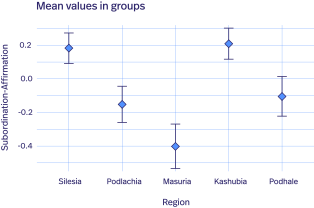
The strongest positive attitude towards the use of a collateral language in both private and public life is found in Kashubia (average 0.21) and Silesia (average 0.18): i.e., regions where the language has been officially recognized as a regional language or where the majority of inhabitants support efforts to have it recognized. Further emancipation measures reinforce the perception of it as a fully-fledged language.
In Kashubia, in particular, since the Act on Minorities came into force in 2005, people have become accustomed to the presence of a collateral language in places and domains where it was not previously used. Even if they do not speak Kashubian in these places themselves, they do not consider it impossible or inappropriate. A man who has engaged with Kashubian issues all his life says:
M_80_Kasz: Now it is appropriate everywhere. There used to be places where it would provoke them to make fun of it (…) but now it is appropriate everywhere. I don’t know of any place [where it is not appropriate].
When asked in which places it is appropriate to speak Kashubian, one of the interviewees in Kashubia presented this issue in a similar way:
F_49_Kasz: For me, the answer should be that it is appropriate everywhere. But if you're not understood, you have to switch to words and a way of speaking that the other person can understand. This is out of respect for the other person. I think it's appropriate everywhere: at home, in offices and in parliament. I wouldn't speak Kashubian everywhere though, because I know I wouldn't be understood.
ND: So, in a situation where you are among people who don't know Kashubian?
F_49_Kasz: It is polite to speak in a way that the other person will understand.
Like many of our interviewees, the Kashubian woman does not see any situations in which it would be inappropriate to speak Kashubian. However, she believes that the condition for using the language is that what is said is understandable. Therefore, regardless of the location, Kashubian can only be used where it is the norm (i.e., in areas designated as ‘Kashubian’). Otherwise, one should switch to Polish. The same applies when speaking in the presence of people who do not know Kashubian. Ideologies that impose subordination are thus quite strong in qualitative research, despite the strong affirmative attitude towards the possibility of using the language everywhere that is declared in surveys.
There have also been major changes in public discourse in Silesia regarding the appropriateness of using Silesian in different domains. For supporters of Silesian emancipation, Łukasz Kohut’s speech in the European Parliament in 2020 was symbolic. In recent years, Silesian has also appeared more frequently in written form on local government public signs (Mętrak, 2024). With further discussions on the unsuccessful attempt to amend the Act on Minorities, Silesian has also found its way onto the parliamentary podium. All of this impacted the strength of affirmative attitudes towards the use of Silesian outside of the private sphere. One of our interviewees from Silesia discusses the positive attitude towards using Silesian in various domains, including public ones:
F_43_Silesia: I speak Silesian at home, with my family, at work, because we are mainly Silesians in our group. Even our boss, who is not a Silesian, is starting to speak Silesian with us, so... There are official moments when Silesian is not used. Although I will tell you that this is the case in government offices. Those days are gone... You come to the city hall and speak Silesian. You can speak Polish, but if you start speaking Silesian, no one will be surprised and the lady on the other side will respond in the same way. So no, it’s cool, cool, in my opinion, everything is going in the right direction. And that's how it should be. We shouldn’t be ashamed of it.
This example illustrates how an affirmative attitude towards language use can lead to a change in language practices. Previously stigmatized practices, such as speaking Silesian at the workplace, are now seen as normal by a Silesian woman, as evidenced by the lack of shame felt by people speaking this language. It is also interesting to note how such an attitude influences the creation of new speakers. In a community where speaking Silesian is the norm, even outsiders (represented by the boss) learn and begin to speak the language.
In Podhale and Podlachia the average of Subordination/Affirmation is -0.10 and -0.15 respectively. This clearly demonstrates acceptance of diglossia. Members of these groups believe that collateral languages can be used in private, family, neighbourhood, and community settings. However, using them in public places is considered inappropriate. Although language practices may extend beyond private and community life, and collateral languages are sometimes used in public places (especially in direct conversation with a person performing official functions, rather than in official documents), it is generally believed that these areas should be reserved for the state language. People who use local languages are expected to adhere to this principle of linguistic subordination. The following statements illustrate diglossia in both regions very well, and what is emphasized is also notable. First, let us quote a resident of Podlachia:
M_65_Podl: In Hajnówka [the centre of the region where Podlachian is spoken] we speak Polish in shops and offices. At the market, for example, I can tell that these people are from the countryside and are selling eggs and milk, so it’s worth speaking to them in Podlachian. You can always haggle for a zloty there.
The man draws a clear distinction between the local and national languages. However, he acknowledges that speaking Podlachian is sometimes beneficial. Nevertheless, the norm of linguistic subordination is quite strong – it is considered inappropriate to speak in the collateral language to strangers. One of the younger interviewees, who also says that she feels judged negatively when she speaks her own language, illustrates this point.
F_21_Podl: I definitely speak Podlachian in an environment where I know I can allow myself to do so and where I feel comfortable. For example, I speak Podlachian at home or with friends. This is also true of local people who understand and like it, and who speak that way themselves. At meetings or parties, we often speak Podlachian, and local songs are played, of course.
GAŻ: You said, ‘When I can allow myself to do so.’ When can’t you allow yourself to do so?
F_21_Podl: I often can’t when I'm with people who don’t know the language and have never learnt Russian, for example, as they find it hard to understand. I also feel that their attitude is rather negative.
In Podlachia, therefore, the feeling that it is inappropriate to use the language in certain places stems from the concern that outsiders may react negatively to it. A Podhalanian interviewee, however, has a different opinion:
M_53_Podh: I am not in favour of speaking the Podhalanian dialect in government offices. You have to sign documents and get stamps there. It’s important that everyone understands each other clearly, and I don’t agree with using the dialect in official settings. Polish is the official language, and it’s clear that it should be used. We are Podhalanians with a dialect, and we are very happy about it. We should use our language wherever we can. However, where it is not possible, we should simply use pure Polish.
Here, there is a clear distinction between the private sphere, where Podhalanian is spoken, and the public sphere, especially the official sphere. According to our interlocutor, it is not only inappropriate to speak the collateral language in the public sphere, it is also completely unacceptable. What is public belongs to the state’s sphere and the language of the state is the dominant language. Therefore, the subordination to Polish as a language of official contact and the affirmation to use Podhalanian in private life are equally strong.
Masuria has the weakest permission for the use of a collateral language in various places (average -0.40). This strong subordination is related to the fact that Masurian has never had a status that allowed it to extend beyond the private sphere. Although it appeared occasionally in the press from the 19th century onwards and was included as a separate category in censuses from 1890 until World War II, public use in schools, offices and the army was reserved for one of two competing languages: German until 1945 and Polish thereafter (Szatkowski, 2023). Today, however, it seems that the lack of language skills among the region's inhabitants makes the use of Masurian seem pointless and inappropriate. One person involved in Masurian affairs admits:
M_59_Maz: Because I have a strong sense of identity, I identify with the Masurians — our ancestors and forefathers. I think it would be interesting to try speaking this language in private or at cultural events.
The challenge lies not in the appropriateness of using Masurian in various places, but in its symbolic presence in community life beyond the oldest generation of ‘rememberers’ and Masurian activists.
Graphical representation of ELV in regions
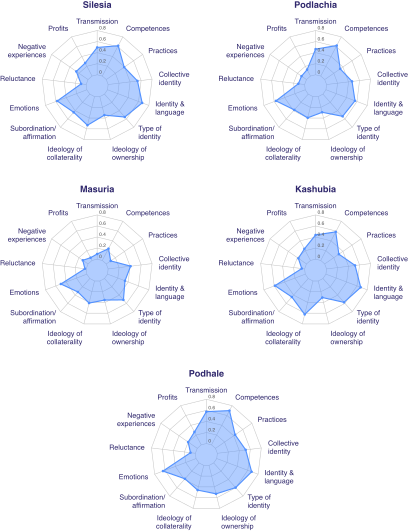
To compare the multidimensional profiles of the five regions across a set of ELV dimensions, a series of radar plots was constructed (Figure 4). These visualizations aimed to provide an intuitive, comparative overview of how the regions differ in terms of their average scores on various dimensions of ELV. Prior to visualization, all 13 aspects of ELV were rescaled to a 0–1 range to ensure comparability, where 0 represents the minimum value and 1 the maximum. The variables Transmission and Competences were originally measured on ordinal scales. To allow their levels to be compared with other aspects of ELV, they were treated as numeric variables and similarly rescaled to the 0–1 scale. The values displayed on the radar plot represent the mean value of each ELV aspect within a given region.
Each plot represented a single region and displayed the thirteen selected dimensions, arranged clockwise. The variable Transmission was anchored at the top of the plot to standardize orientation across panels. To enhance visual clarity without obscuring gridlines or axis labels, the polygonal area representing each region’s profile was rendered in a semi-transparent blue fill.
| Latent variable | Silesia | Kashubia | Podhale | Podlachia | Masuria |
|---|---|---|---|---|---|
| Collective identity | 0.231 | 0.128 | 0.116 | -0.198 | -0.516 |
| Identity and language | 6.752 | 6.777 | 6.747 | 5.637 | 3.379 |
| Type of identity | -0.034 | 0.104 | 0.201 | -0.092 | -0.215 |
| Ideology of language ownership | 3.416 | 3.103 | 5.313 | 2.892 | 3.553 |
| Ideology of collaterality | -0.165 | -0.653 | 0.202 | 0.556 | 0.455 |
| Language practices | 0.328 | -0.122 | 0.519 | 0.039 | -1.282 |
| Subordination/Affirmation | 0.181 | 0.208 | -0.103 | -0.151 | -0.398 |
| Emotions | -0.059 | 0.038 | 0.226 | -0.064 | -0.307 |
| Reluctance to use language in public | 0.114 | 0.064 | 0.110 | 0.146 | 0.034 |
| Negative experiences | 0.385 | -0.015 | 0.097 | -0.400 | -0.334 |
| Profits | 0.196 | 0.111 | 0.200 | -0.236 | -0.484 |
The graphs show that the ELV of communities using collateral languages in Poland follows a similar pattern, but differs in terms of the strength of individual aspects. This is particularly evident in Masuria, where the differences are most pronounced. In this region, ELV is weaker than in other regions, and this applies to all characteristics (see Table 4). Demographic changes after World War II and the persecution of the Masurian community led to the dispersion of the group, which is reflected in identity-related issues and the cessation of language use (all linguistic dimensions). This has also contributed to language ideologies that perpetuate the perception of Masurian’s low prestige and relatively weak attitudes towards the language.
Most aspects of ELV in Podhale are relatively strong. The results are characterized by strong values relating to language: intergenerational transmission, self-assessment of language competence, and practices (0.52). All these variables are the strongest among the investigated regions. Attitudes towards the language are also the strongest, with positive emotions (0.23) and the belief that knowledge of the language can bring benefits, both in terms of solidarity and status (0.2). Negative attitudes are weaker (0.01). It is also noteworthy that the results for ideologies related to language status are lower than in Kashubia or Silesia (0.2 to -0.65 and -0.16). Although the Podhalanians use their language, they do not want it to have official status or to be taught in schools and protected by law, which could have consequences in the future. Conversely, identity characteristics are interesting, particularly the stronger protection of the group from outsiders than in other regions (collective identity 0.12; type of identity 0.2) and the strong ideology of language ownership (5.3). While this characteristic currently testifies to the strength of the Podhale ELV, it may also weaken the ELV in the face of slow but steadily declining intergenerational transmission.
Silesia is also characterized by fairly strong results of our measured ELV aspects. Notably, there is a strong sense of identity in various forms, including linguistic (collective identity 0.23), combined with a high degree of openness to speakers from outside the community (ideology of language ownership 3.42). This is probably related to the acceptance of people who came to the region in the past looking for work in heavy industry and who assimilated into the Silesian-speaking community. The linguistic features are strong (language practices 0.33), albeit weaker than in Podhale. The weakening transmission of the language may pose a threat. Silesians have a strong sense of the prestige of their language (the ideology of collaterality is stronger than in Kashubia but definitely weaker than in other regions, -0.17) and strive to ensure that it can be used in various contexts. In Silesia itself, emotions relating to the language are neutral (-0.06) – speaking Silesian is rather a natural occurrence than a source of pride. At the same time, however, the group is affected by negative experiences related to the language (0.39), but to some extent has learned to turn these experiences to their advantage (profits 0.2).
While close to the results from Silesia, most aspects of ELV in Kashubia measure slightly lower. For a community characterized by a strong identity (0.13) and attachment to the language (6.77 for language and identity, the strongest among the regions), the greatest challenge is maintaining the transmission and use of the language (language practices -0.12). The dimension of ELV related to language is clearly weakening. Despite the high perceived status of the language (the ideology of collaterality is the weakest among the regions, -0.65) and acceptance of its use in various contexts, these language ideologies do not directly translate into practice. This may be the greatest future challenge for the ELV of the Kashubian community. Attitudes towards the language are also alarming. While there are positive emotions (0.04), people in Kashubia have a weaker sense of the benefits associated with their language than those in Podhale and Silesia (profits 0.11 compared to 0.2), even though Kashubia is the only region where the language is legally recognized.
In general, the analysed ELV elements in Podlachia are notably weaker than in the other regions (except for Masuria) in many respects. The lowest scores are found in characteristics related to the status of the language (the ideology of collaterality is the strongest with an average of 0.56). It is clearly perceived as being lower in the hierarchy than the dominant language and, as a result, is not granted protection, the right to be taught in schools, or to be used in public places. Podlachian is transmitted and used as a community language (language practices 0.04), but the ELV’s dimensions in this area are also weaker. The weakening of collective identity (-0.2) is influenced by the fragmentation of the language community between two official minorities (Belarusian and Ukrainian), and by regional actors disregarding collective identity at the local rather than national (minority) level. Although they value the language highly, inhabitants of Podlachia do not feel they can gain profits from it (-0.24).
Conclusion
In this article, we have presented a dynamic model of ELV inspired by classical studies of both ethnolinguistic and linguistic vitality and the achievements of critical sociolinguistics. The model proposed in our research (Figure 1), sheds new light on the ELV phenomenon. Our intention was to present the ELV of the collateral language communities in all its comprehensiveness and complexity. Based on the results of the Ethnolinguistic Vitality Questionnaire, we first selected concepts recognized by sociolinguistics as important for the functioning of endangered languages. We then identified two crucial factors for language vitality, namely intergenerational transmission and language competences (as observable variables). Using psychometric methods, we devised latent variables and tested their relevance. The tests proved that 11 of these variables were relevant to the ELV of collateral language communities in Poland. We acknowledge that, for other types of language community, different or additional latent variables may be relevant.
The strength of our approach lies in its generalisability – i.e., its applicability in different contexts and to different groups. We developed this model through research into the ELV of five very different collateral language groups in Poland, but it can be applied – with appropriate preparation and adjustments tailored to the specific language group – to other minority communities. The quantitative comparative study allowed us to confirm the functionality of the model by comparing different aspects between regions. This model can also be used to assess the state of the language and the attitudes of speakers in different regions where these groups live, as these factors can differ significantly. We believe that such a study would enable language planning and policy to be tailored to the different needs of people in different territorial units, which is necessary for language revitalisation to succeed (Kroskrity, 2009). Therefore, the model’s applicability does not lie in the questionnaire itself, as it has to be tailored to a specific community. Rather, it lies in the ontological concept of perceiving different aspects of ELV as latent variables that impact other aspects, either strengthening or weakening them. In every case, interpreting the role of latent variables must be based on a deep understanding of the context in which a language community exists.
We decided against creating an ELV scale and instead opted to present the results graphically for each of our regions. Our goal is not to determine the strength of ELV in a given community, but rather: 1) to demonstrate the multidimensionality of the phenomenon, showing how individual variables interact with each other and impact ELV in general; and 2) to identify the aspects of ELV in a given community that are weak, or that determine the group’s potential, so that specific actions to preserve cultural and linguistic cohesion can be incorporated. Observable and latent variables describe only a fragment of the groups’ functioning, but their analysis proves that all ELV characteristics are – to different extents – interrelated. Therefore, we see ELV as a configuration of many variables that influence it and impact the other variables. The calculations we presented (detailed examples of one latent variable for the regions and a general scheme of the distribution of ELV variables for a specific group) are therefore intended to provide a basis for further interpretation. This interpretation is based on the ‘objective’ context of how the group functions, where demography, legal status, minority-majority relations, and institutional support are of fundamental importance. Additionally, our research is supported by qualitative research conducted in communities, which helps us to understand the individual aspects of the strength of ELV. While it is possible to present ELV findings in graph form, interpreting these graphs requires in-depth knowledge of the community and should be accompanied by a descriptive report.