 https://orcid.org/0000-0002-9720-4602
Introduction
A structural political paradox is unfolding across Europe. As right-wing populist movements, from Geert Wilders’ Party for Freedom (PVV) in the Netherlands to the Alternative for Germany and the Sweden Democrats, achieve unprecedented electoral prominence by framing Muslim immigrant communities as existential threats, a new generation of second- and third-generation Muslim citizens increasingly refuses political invisibility (Nielsen, 2013). These are not migrants. They are European citizens born on European soil, educated in European schools, holding European passports, and responding to political exclusion with organised, assertive, and digitally mediated democratic participation (Dancygier, 2017). Understanding how and why this response has emerged and what forms it takes is among the most consequential analytical questions facing European political science today.
The concept of digital Islam is central to answering this question. Digital Islam examines how Islamic knowledge, authority and community are produced and contested on digital platforms (Echchaibi, 2011; Bunt, 2018). Online platforms let younger Muslims access religious knowledge, build solidarities, and contest stigmatising narratives outside established institutions such as mosque boards (Campbell, 2012; Evolvi, 2019). Roy (2004) reads this as part of a broader de-territorialisation of religious identity. This article does not study religious practice online; it asks how a political party draws on these digitally mediated identities in its communication.
The political implications of this transformation remain only partially theorised. A substantial body of quantitative, survey-based scholarship has directly examined Muslim political participation, turnout, and voting preference in the Netherlands, including work on civic community and ethnic networks (Fennema and Tillie, 2001), majority attitudes toward Muslim political organisations (Bot and Verkuyten, 2018), the propensity to vote for DENK (Dutch meaning for ‘Think’), NIDA (Arabic meaning for ‘call or appeal’), and a left-wing to far-left socialist political party in the Netherlands - BIJ1 (Lubbers, Otjes and Spierings, 2024), religiosity and electoral turnout among Muslims (Kollar, Geurts and Spierings, 2024), and the discrimination–participation gap more broadly (Spierings and Vermeulen, 2024; Oosten et al., 2024). This literature has not yet examined supply-side mobilisation, which this paper addresses: how a minority-interest party constructs, on digital platforms, the identity and grievance appeals that this survey-based literature links to support for it. Scholarship on European Muslim communities has, by contrast, focused predominantly on securitisation, radicalisation, and the threat of Islamist extremism, leaving qualitative, party-level digital mobilisation comparatively unexamined. When scholars have engaged with Muslim political participation, Koopmans (2010) and Banting and Kymlicka (2006) have typically examined it through the lens of integration theory, asking whether Muslims successfully assimilate into mainstream political parties and civic norms (Fitzpatrick, 2008). This perspective fails to capture the more substantial and analytically important phenomenon. The construction of a new political infrastructure through digital platforms operates neither through assimilation nor radicalisation but through assertive democratic agency exercised within the framework of the existing political system. Consequently, this study seeks to fill this gap by offering a theoretical account of how digital Islam functions as the engine of a new kind of European minority politics.
Unlike mainstream Dutch parties, DENK communicates directly with Muslim youth using culturally resonant language, multilingual content, and issue framing anchored in the lived experience of discrimination and institutional exclusion. This distinguishes it fundamentally from parties such as the Labour Party (PvdA) or GroenLinks (a green and social democratic political party), which include Muslim candidates on their lists for descriptive representation but consistently fail to advocate substantively for Muslim policy interests (Loukili, 2021). DENK’s distinctiveness lies not only in its candidates, whose lived experiences of discrimination and institutional exclusion inform its appeal, but also in its method. A digital-first communication strategy that uses Islamic identity markers, transnational solidarity, and local grievance politics simultaneously to build a loyal community may contribute to electoral resilience (Otjes and Krouwel, 2019).
This mobilisation does not consider Dutch Muslims as an undifferentiated bloc. The Dutch Ethnic Minority Election Survey, 2021, shows that the propensity to vote for DENK, NIDA, and BIJ1 is concentrated among specific segments of the electorate that are religious, multiculturalism-supportive voters who report experiencing discrimination, rather than being distributed evenly across the community (Lubbers, Otjes and Spierings, 2024). The empirical chapters below examine how DENK’s digital communication mobilises these specific segments through two linked registers, an identity register and a grievance register, that together operationalise, at the level of a political party’s communication strategy, the de-territorialised and horizontally networked religious identity that Roy (2004) and Campbell (2012) locate at the level of the individual believer. Here, the literature theorises digital Islam as a change in religious authority and belonging; this paper asks what happens when a political party deliberately organises around that changed structure of belonging.
The remainder of this paper is structured as follows. The following section reviews existing theoretical frameworks on digital Islam, mediatisation, counter-publics, and minority representation. The subsequent section sets out the DENK in its Dutch context, tracing the legacy of pillarisation and post-war migration, the rise of radical-right mobilisation, the party’s origins and positioning, and its electoral record. Further, the data and methods section describes the research design, the observation period and accounts, the purposive sampling of posts and audience comments, the three-code framework, and the use of Social Blade data. The penultimate section presents the findings, examining identity signalling, grievance mobilisation and transnational solidarity in turn. It then analyses audience comments and DENK’s digital election strategy. The final section examines these findings together into the paper’s conceptual contribution, the dual mobilisation strategy and the Digital Virtual Pillar. The paper concludes by arguing that the implications of the DENK case for minority-interest politics in Europe and setting out directions for future research.
Theoretical Framework
The intellectual foundations of this paper draw on four bodies of scholarship that together provide a framework for theorising the digitalisation of Islam as a vehicle for minority participation in democracy. The first is literature on globalised and digital religion. Olivier Roy's foundational work argues that young Muslims in the West are constructing a de-territorialised religious identity, detached from their parents’ homeland cultures and reassembled from global digital networks (Roy, 2004). This new Islam in the digital age is simultaneously more individualised and more universally connected. Where Roy’s framework emphasises religious reconstruction, this paper extends his argument to its political implications: how does de-territorialised digital Islamic identity translate into organised democratic participation? Answering this requires the additional analytical tools provided by the remaining three bodies of scholarship.
Campbell’s work on digital religion demonstrates how online platforms restructure religious authority by democratising access to Islamic knowledge and creating horizontal solidarity networks that bypass traditional mosque hierarchies (Campbell, 2012; Bunt, 2018). For DENK’s target demographic, these horizontal networks plausibly constitute one pathway into political consciousness, although the direction of this relationship cannot be established from digital ethnographic data alone. An equally consistent alternative reading is that young Muslims with pre-existing political sympathies selectively follow DENK’s accounts rather than DENK’s content generating that sympathy; survey evidence on the correlates of propensity to vote for DENK (Lubbers, Otjes and Spierings, 2024) is consistent with both a mobilisation and a selection account. This study treats mobilisation as a working hypothesis motivating the qualitative analysis that follows and returns to the need for experimental data capable of adjudicating between mechanisms in the conclusion. The mediatisation of politics framework, developed by scholars such as Strömbäck (2008), provides the second major analytical lens: political actors do not simply use media as a neutral channel; they transform their behaviour, rhetoric, and institutional logic to conform to media logic.
DENK’s practice of circulating clipped and subtitled parliamentary confrontations on its own channels is consistent with this logic; whether speeches are written with clipping in mind cannot be established from our data. Nancy Fraser's theory of counter-publics, which are alternative discursive arenas where marginalised groups develop their identities and formulate oppositional interpretations of mainstream norms (Fraser, 1990), provides the third theoretical anchor. DENK’s digital ecosystem can be read as a counter-public, as Loukili (2021) argues for DENK’s and NIDA’s earlier social-media use: a space where young Dutch Muslims can articulate grievances, celebrate identity, and organise politically without the mediation of mainstream Dutch media, which has historically framed Muslim presence as a security concern. The fourth body of scholarship concerns representation. The distinction between descriptive representation (having politicians who look like you) and substantive representation (having politicians who fight for your interests), elaborated by Pitkin (1967) and applied to European minority politics by Loukili (2021), helps explain DENK’s specific electoral appeal. Mainstream parties offer descriptive representation by placing Muslim candidates on their lists; DENK presents itself as offering substantive representation, and its platforms make its parliamentary advocacy visible to its audience.
Ruud Koopmans’ influential work on integration offers a necessary critical counterpoint. Koopmans (2010) argues that strong multicultural policies can undermine civic integration by encouraging ethnic enclaves. This paper engages with this argument not to endorse it but to show how DENK’s strategy can be read as a rejoinder, turning the language of civic integration on its head by demanding acceptance rather than assimilation. Where integration discourse asks minorities to change to fit the host society, DENK’s digital counter-public demands that the host society’s political institutions recognise and accommodate their citizens as they are. This paper argues that DENK pursues this demand through the institutions of liberal democracy: parliament, the ballot box, and constitutional law, making it simultaneously a challenge to and a vindication of European democratic norms.
These four bodies of scholarship can be read as a sequence. Roy (2004) and Campbell (2012) established that digital platforms have restructured where and how Islamic identity and authority are produced. Strömbäck’s (2008) mediatisation framework explains how a political actor operating in this restructured environment must adapt its own rhetoric and timing to platform logic to be seen within it. Fraser’s (1990) counter-public theory specifies what such an actor can build once adapted: a discursive space where a marginalised group develops oppositional narratives outside mainstream gatekeeping. Pitkin’s (1967) descriptive/substantive distinction, as applied by Loukili (2019, 2021), suggests why counter-public communication may matter electorally: it may be experienced as substantive rather than merely symbolic representation. Koopmans (2010) offers a counter-current, reading the same identity-affirming strategy as encouraging separateness rather than civic incorporation and integration.
DENK in Context
Pillarisation, Migration and the Representation Gap
DENK emerged from a specific trajectory in Dutch politics. The traditional Dutch model of pillarisation (verzuiling), which shaped Dutch society from the late nineteenth century until the 1960s, was a consociational arrangement in which deeply divided social groups achieved stable coexistence through institutional separation and elite negotiation (Lijphart, 1975). Catholics, Protestants and Socialists maintained their own schools, hospitals, newspapers, broadcasting associations, trade unions and political parties. The system gave these groups structural recognition, an institutional voice and political representation without requiring cultural assimilation. From the 1960s onwards, however, pillarisation eroded under the pressures of secularisation and individualisation, and Dutch politics became increasingly fragmented, with no comparable institutional mechanism for including new minorities (Lijphart, 1975).
The post-pillarisation era coincided with significant immigration from Turkey and Morocco, first of guest workers (gastarbeiders) in the 1960s and 1970s and then through family reunification (Penninx, 2006). By the early twenty-first century, second- and third-generation Dutch citizens of Moroccan and Turkish descent numbered in the hundreds of thousands, concentrated in Amsterdam, Rotterdam and The Hague. These communities settled as the pillarised institutions that had historically given religious minorities structured representation were dissolving. Without a ‘Muslim pillar’, they were expected to integrate individually into existing parties and civic structures. Despite their demographic weight, Muslim communities long remained politically marginal (Fennema and Tillie, 2001).
Radical-Right Mobilisation
This marginal status has been increasingly politicised by radical-right politicians. The 2002 assassination of Pim Fortuyn, whose campaign had centred on Islam and immigration, and the 2004 murder of filmmaker Theo van Gogh by a Dutch-Moroccan extremist intensified public anxiety about Muslim integration and encouraged the framing of Muslim communities as a security problem. Geert Wilders’ PVV became the largest party in the 2023 election with 37 seats, on a platform that called for banning the Quran, closing mosques and halting immigration. For many second- and third-generation Dutch Muslims, Wilders’ rise meant having their identity publicly questioned, their loyalty doubted, and their belonging denied in the country of their birth (Kian & Ghorashi, 2018).
DENK’s Origins and Positioning
On 13 November 2014, Tunahan Kuzu and Selçuk Öztürk, two Dutch-Turkish members of parliament elected for the Labour Party (PvdA), left the PvdA parliamentary group after a conflict over the party's integration policy. Specifically, opposition to a proposal by Minister Lodewijk Asscher to monitor several Turkish-Islamic organisations and continued as Groep Kuzu/Öztürk. They launched DENK on 9 February 2015 (University of Groningen, n.d.). DENK thus emerged not as a religious party but as a minority-interest party, positioning itself as the political voice of Dutch citizens with a migration background who felt underserved and stigmatised by mainstream parties across the political spectrum (Otjes and Krouwel, 2019).
DENK won three seats in the 2017 general election, the first it contested (Kiesraad, 2017). Its current leader, Stephan van Baarle, in parliament, frames DENK’s demands chiefly in terms of constitutional rights, anti-discrimination law and democratic inclusion rather than religious doctrine. The paper reads this framing, rather than his personal convictions, as relevant to DENK’s post-Islamist positioning in Bayat’s (2013) sense of decoupling religious community interests from theocratic ambition; the paper has no evidence on the party’s reasons for selecting him.
DENK’s leadership separates its political programme from religious doctrine, yet its communication uses religious, ethnic and political symbols. This is not a contradiction. On Bayat’s (2013) account, post-Islamism does not remove religious and cultural symbols from politics; it redeploys them as resources for civic and constitutional claims rather than as a programme for religious governance. This paper therefore treats the Palestinian flag, Arabic greetings and Turkish-language content as overlapping Islamic, ethnic and diasporic identity markers, not as one category. The Palestinian flag signals political and anti-colonial solidarity that extends beyond religious constituents; Turkish-language content marks ethnic and national belonging as much as religion; and Arabic greetings work as shared cultural shorthand regardless of individual religiosity.
Electoral Record (2017–2025)
DENK has won three seats in each of the four general elections it has contested, with 2.06% of the vote in 2017, 2.03% in 2021, 2.37% in 2023 and 2.37% in 2025 (Kiesraad – verkiezingsuitslagen, n.d.-a). Figure 1 sets these results beside DENK’s vote share in municipal, provincial and European elections. This stability held while the party system changed sharply around it, including the PVV’s rise to 37 seats in 2023 and the loss of all twenty New Social Contract (NSC) seats in 2025. A stable result is consistent with a durable core electorate; it does not by itself show that DENK’s digital communication produces that durability.
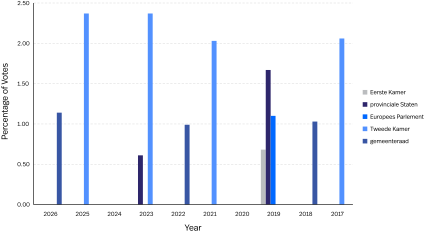
Source: Created by the authors based on data from Kiesraad - Verkiezingsuitslagen (Dutch Electoral Council - Election Results).
The October 2025 snap election was called after the Schoof cabinet, a coalition of the PVV, VVD (People’s Party for Freedom and Democracy), NSC, and BoerBurgerBeweging (BBB – Dutch meaning for Farmer–Citizen Movement - an agrarian and right-wing populist political party), collapsed when the PVV withdrew over asylum policy, making it the second general election in two years. D66 (Democrats 66) achieved its best-ever result with 26 seats, level with the PVV; JA21 (Conservative Liberals political party) rose to nine seats and Forum for democracy (FvD) to seven, while NSC lost all twenty of its seats (Kiesraad – verkiezingsuitslagen, n.d.-a). DENK again won three seats.
DENK’s electoral durability should not be read as evidence of homogeneous support among Dutch Muslims. Evidence from the Dutch Ethnic Minority Election Survey 2021 shows that the propensity to vote for DENK is concentrated among religious, multiculturalism-supportive voters who perceive discrimination, rather than spread evenly across the Muslim population (Lubbers, Otjes and Spierings, 2024). Muslim citizens also vote less often than the national average (Spierings and Vermeulen, 2024). Non-voting is therefore as much a part of this picture as support for DENK.
DENK’s national share understates its local strength. In 2025 it received 10.4% of the vote in Rotterdam (Gemeente Rotterdam, n.d.) and 7.7% in Amsterdam against 2.37% nationally, and it was the largest party at several polling stations in Amsterdam (Municipality of Amsterdam Klaas-Bindert de Haan, n.d.). This concentration mirrors the residential concentration of Dutch citizens of Turkish and Moroccan origin, on whom DENK’s vote largely rests (Vermeulen et al., 2020). Our data do not allow us to attribute it to DENK’s digital communication.
Data and Methods
Research Design
The study relies on digitally situated qualitative content analysis informed by the principles of digital ethnography (Hine, 2015; Pink et al., 2016). Digital platforms are viewed not only as repositories of political messages but also as socially constructed sites where identities are performed, grievances vented, communities addressed, and political participation coordinated. Digital platforms can be valid sites for social research because they offer access to the communicative practices through which political identities and collective relationships are constructed (Boyd & Crawford, 2012). However, the present study does not claim to be a conventional ethnography. It did not involve direct interaction with users. Its ethnographic dimension rests on long-term and repeated observation of the public digital environment of DENK, attention to the interaction between content, platform practices, political context, and audience responses, and on the reflective analytical notes kept throughout the research period.
The authors are researchers based in India, with no command of Dutch and a basic command of Turkish and Arabic, and have no affiliation with DENK or any other Dutch party. This outsider’s perspective reduced partisan proximity to the material but limited access to linguistic and cultural nuances that this paper addressed through the translation checks described in the subsection on ‘Audience Comments’.
Observation Period, Accounts and Sampling
Digital observations were conducted between January 2024 and April 2026, with intensified observations during the electoral period around the October 2025 general election. During the principal campaign period, the selected platforms were reviewed weekly and election-related content was monitored thrice a week. Observations were limited to DENK’s official YouTube channel (@DENKnl), its official Instagram account (@denknl) and the public accounts of leading party representatives, such as Stephan van Baarle (@stephanvanbaarle), El-Abassi and Doğukan Ergin. The field notes were reflective and documented recurring narratives, shifts in campaign focus, platform-specific communication practices, major political events, and initial interpretations of audience engagement.
DENK’s official YouTube and Instagram accounts were selected because they are the main channels through which DENK addresses the public with audiovisual campaigning, political messages, audience engagement, and circulation of identity-based narratives. In addition to official party accounts, the study also considered the public accounts of selected party representatives who had prominent organisational and representative roles within DENK and regularly communicated party positions to digital audiences. Their choice as key party leaders is thus based on their formal political roles, public visibility, and participation in parliamentary and electoral communication. To contextualise their digital reach, monthly changes in followers and subscribers for the official accounts were recorded for the study period, January 2024 to April 2026, using Social Blade (see Figures 2 and 3).
Because the aim was to examine how DENK articulates identity and grievance claims, not to estimate their frequency across all of its output, this paper drew a purposive, criterion-based sample (Patton, 2014). A post was eligible if it was published in the observation window, addressed a political issue rather than logistics such as event announcements, and carried at least one of the three codes defined in the subsection on ‘Coding and Analytical Procedure’. From the eligible posts, the paper selected those that ranked among the most popular and observation-based (YouTube) or pinned and most viewed (Instagram) eligible posts within one of the event windows, or were pinned by the official account, which signals the party’s own prioritisation. This yielded 19 posts: seven from YouTube and twelve from Instagram (See Table 1 and Table 2). The sample therefore over-represents high-visibility, politically salient communication and does not represent DENK’s routine output.
| Platform | Account | Type | Followers or subscribers | Posts published, Jan 2024–Apr 2026 | Posts sampled |
|---|---|---|---|---|---|
| YouTube | @DENKnl | Party | 20.3k | 262 | 7 |
| @denknl | Party | 57.6k | 650 | 11 | |
| @stephanvanbaarle | Party leader | 50.4k | 450 | 1 | |
| Total | 19 |
Source: Created by the authors from the YouTube and Instagram platforms in May 2026; followers and subscribers counts recorded over the same time period.
Figures 2 and 3 show the monthly net change in subscribers and followers of the two official party accounts during the observation period. They describe audience growth, not engagement with individual posts, and serve only as context (see the subsection on ‘Social Blade Data’).
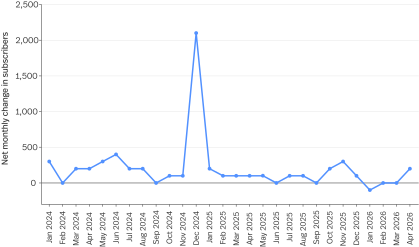
Source: Created by the authors using the YouTube data from Social Blade
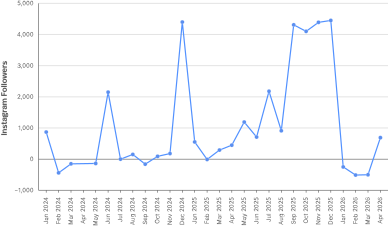
Source: Created by the Authors using the Instagram data from Social Blade
Sampling of Posts
Between January 2024 and April 2026, the observed accounts (the official YouTube channel and Instagram account, together with the leaders’ accounts listed above) published 262 videos on YouTube and 1100 posts and reels on Instagram. From this population, 19 items were selected for close analysis: seven from YouTube and twelve from Instagram. The selection was purposive rather than random, because the aim was to trace how identity, grievance, and transnational appeals are articulated in DENK’s communication, not to estimate how often each appears across all of its output. Items were included when they (a) clearly addressed at least one of the three codes described below; (b) attracted high engagement, were pinned by the account, or coincided with a major political event such as the October 2025 election campaign; and (c) drew enough public comments for audience responses to be observed.
Audience comments
Public comments beneath the selected posts were analysed as a second, smaller data source. From the 19 posts analysed, 7 from YouTube and 12 from Instagram, a total of 300 comments were retained for analysis. Comments were selected from each post based on platform ranking, number of likes, and level of engagement, with priority given to top-ranked and highly engaged comments. Comments were coded inductively into sentiment categories (Figure 4) and discourse types (Figure 5). Comments in Dutch, Turkish, Arabic, and other languages were interpreted with the help of machine translation and paraphrased in the text, and no commenter is identified, in line with the Association of Internet Researchers (AoIR) ethical guidelines (Franzke et al., 2020). Comment sections are self-selecting and are not representative of DENK’s audience or electorate, so the shares reported in Figures 4 and 5 describe the coded comments only.
Coding and Analytical Procedure
Posts were coded with a three-code framework: (A) Identity Signalling, (B) Grievance Mobilisation, and (C) Transnational Solidarity. The codes were developed deductively and inductively. Initial categories were informed by scholarship on minority political representation, digital Islam, counter-publics, recognition politics, grievance mobilisation and transnational political identification.
Identity Signalling was applied to content foregrounding Muslim, migrant, ethnic, cultural, generational, or minority identity; using religious or culturally resonant symbols; challenging assimilationist expectations; or presenting minority identity as compatible with Dutch citizenship and democratic participation. Grievance Mobilisation was applied to content addressing discrimination, Islamophobia, unequal political representation, socioeconomic marginalisation, housing, education, employment, policing, or other forms of perceived institutional exclusion. Moreover, transnational solidarity was applied to content that connected DENK’s domestic political identity to conflicts, humanitarian issues, diasporic attachments, or justice claims outside the Netherlands, including issues affecting Muslim or migrant communities.
Posts were coded at the level of the individual post or video, with caption, visual material and speech treated as one communicative unit; a post could receive more than one code. Comments were coded separately at the level of the individual comments.
Social Blade Data
In addition, Social Blade data provided quantitative contextualisation of the qualitative findings. This paper did not use Social Blade metrics to infer political beliefs, demographic characteristics, voting behaviour, or motivations of followers. Gains in views or followers were not regarded as evidence of persuasion or electoral support. However, Social Blade has some limitations. Its data are largely composed of publicly observable platform metrics and may contain estimates, incomplete historical records, delayed updates, or inconsistencies resulting from changes in platform interfaces and data access policies. It cannot distinguish between supportive engagement and criticism, automated activity, incidental exposure, or attention generated outside the Netherlands. Consequently, Social Blade was considered a supporting source of contextual evidence rather than an independent measure of political mobilisation or campaign effectiveness.
Analytical Approach
The three-code framework provides an empirical basis for investigating what this article refers to as DENK’s dual mobilisation strategy. The idea outlines how demands for cultural recognition could be linked by minority-interest parties to claims about material inequality, institutional discrimination, and political representation. Rather than treating identity politics and socioeconomic grievances as mutually exclusive forms of mobilisation, the framework examines how they are articulated together in digital political communication.
The coded material is then interpreted through two concepts, the Digital Virtual Pillar and post-Islamist digital civic mobilisation (Bayat, 2013). Both are defined and developed in the Conceptual Contribution section, after the findings on which they rest have been presented.
Findings
Identity Signalling: Building a Trust Infrastructure
Table 2 records the platform and account handle for each of the 19 posts analysed. Of these, seven originated from YouTube (@denknl) and twelve from Instagram(@denknl and @stephanvanbaarle). Code B (Grievance Mobilisation) appears in five of seven YouTube videos and nine of 12 Instagram posts, whereas Code C (Transnational Solidarity) is concentrated in three of seven YouTube videos and four of 12 Instagram posts. These differences suggest at most that Instagram is used somewhat more for identity-oriented communication, while grievance and transnational content are spread across both platforms. The platform-specific findings discussed below should therefore be interpreted in light of these differences. Because the 19 posts were purposively selected (see the data and method section), these counts describe the analysed corpus and cannot be generalised to DENK’s total output.
The most immediately recognisable element of DENK’s digital strategy is the systematic use of Islamic and Palestinian identity markers as a visual and linguistic shorthand. The party’s logo incorporates the Palestinian flag alongside the party name, a design choice that communicates transnational solidarity before the reader has read a single word. Party representatives appear in parliament and on social media wearing Palestinian-flag badges, a visual signal amplified through carefully edited clips that circulate across platforms. This visual grammar is interpreted here as strategic rather than merely decorative. In a political context where Muslim identity is routinely presented by right-wing politicians as something requiring justification or apology, DENK’s visual assertion of that identity in the highest democratic institution of the Netherlands can be read as communicating to Muslim youth that their identity requires no apology and admits no compromise. The prominence of Palestinian symbols also needs to be read against the wider context of the war in Gaza, which is discussed in the section on transnational solidarity below.
The linguistic register of DENK’s content is deliberately multilingual. Arabic greetings, Eid Mubarak, Alhamdulillah, and Insha Allah, appear consistently in posts and leader statements, functioning as digital shorthand: pre-political trust signals that communicate cultural belonging before any policy content is consumed. Turkish-language content maintains connections with Dutch-Turkish communities that consume media in both languages. DENK’s trilingual Eid Mubarak post in May 2025, addressing the Dutch-Turkish and Dutch-Moroccan communities simultaneously in Turkish, Arabic, and Dutch, generated celebratory engagement from across the party’s full cultural constituency, suggesting a capacity to signal inclusivity across both major Muslim communities simultaneously (Cesari, 2004). As one commenter among the coded comments (see Figures 4 and 5) put it, ‘finally a party that speaks our language,’ a statement that is simultaneously literal and metaphorical, referring to actual linguistic register and to cultural-political voice.
This identity signalling strategy embodies what Bayat (2013) terms post-Islamism: religion deployed not as a dogmatic program for state transformation but as a cultural resource that authorises democratic political agency. DENK does not campaign for the implementation of Islamic law; it campaigns for the constitutional recognition of Muslim identity as a legitimate, unqualified component of Dutch citizenship. The Palestinian flag is a statement not of theology, but of solidarity, and in the political context of a country where that solidarity is publicly contested, the act of solidarity becomes a political statement.
Grievance Mobilisation: From Local to Legislative
The second strand of DENK’s digital strategy addresses material grievances at the intersection of local socioeconomic conditions and civic rights issues. Grievance mobilisation was the most frequent code in the corpus (14 of 19 posts), with a consistent focus on what this study categorises as everyday injustice: housing discrimination in urban neighbourhoods, unemployment among youth with a migration background, police profiling, and institutional racism in schools and workplaces. These issues are not presented as abstract policy debates; they are framed as shared, visceral, personal experiences, a communication style calibrated precisely for social media audiences who respond to the personal register of the speaker.
A particularly significant example emerged in early 2025, when DENK parliamentarian Doğukan Ergin filed formal parliamentary questions following the Dutch Broadcasting Foundation (Nederlandse Omroep Stichting - NOS) investigation that revealed that more than 180 Dutch schools had imposed restrictions on student prayer (NL Times). DENK’s digital response framed the issue as a violation of Article 6 of the Dutch Constitution concerning freedom of religion and used the term “Krankzinnig!” (“Insane!”) in social media posts. In doing so, the party transformed a complex legal-administrative issue into an immediate and emotionally legible civil rights narrative. The clip generated significant engagement, with comments reflecting both fierce community solidarity and equally fierce opposition from right-wing users. One plausible reading is that this polarised comment dynamic did not undermine DENK’s mobilisation narrative. Hostile comments from right-wing users, which form only a small share of the coded comments (Figure 4), may have been read by supporters as validating DENK’s core narrative that mainstream Dutch society is institutionally hostile to Muslim identity; the data cannot show whether this made mobilisation through DENK feel necessary for community self-defence.
The 2025 parliamentary debate on antisemitism provides a further illustration. When a motion on antisemitism was adopted by the Dutch parliament while a motion on Islamophobia was simultaneously rejected, DENK’s digital response was immediate and pointed: ‘double standards in this parliament’ (Kouwenhoven et al., n.d.). The Instagram post documenting this juxtaposition, published in April 2026, among the most recent in the dataset, suggests that DENK’s grievance mobilisation strategy has continued and possibly intensified, which is consistent with the durability of the Digital Virtual Pillar as an ongoing infrastructure rather than a one-off electoral phenomenon.
Transnational Solidarity: Connecting Local Votes to Global Causes
The prominence of Palestinian symbols and Gaza-related content in DENK’s communication, noted above under identity signalling, has to be read against the wider context of the war in Gaza since October 2023. In September 2025, the UN Human Rights Council’s Independent International Commission of Inquiry concluded that Israel has committed genocide against Palestinians in Gaza (Independent International Commission of Inquiry, 2025), a finding that Israel rejects and that remains politically contested. DENK and other critics argue that mainstream Dutch parties and the government have failed to respond adequately to the situation. Against this background, the heightened use of Palestinian symbols can be interpreted not only as a marker of ethnic or religious identity but also as a response to a crisis that DENK’s supporters see as neglected by Dutch political leaders. This context helps to explain why transnational solidarity recurs across both platforms, in seven of the 19 posts and in a comparable share of comments on YouTube and Instagram.
The third and theoretically most complex strand of DENK’s digital strategy links local Dutch electoral politics to global Islamic causes, most prominently the Palestinian question. DENK leaders regularly connect geopolitical conflicts in West Asia to the economic and political conditions of Dutch Muslim communities, framing foreign policy not as a distant abstraction but as an intimate matter of identity, solidarity, and daily life.
This strategy exemplifies what Appadurai (1996) terms the construction of diasporic public spheres: transnational communities of sentiment that use media to maintain connections across physical borders. For second-generation Dutch-Moroccan or Dutch-Turkish youth who have never migrated but maintain deep cultural ties to Islamic communities globally, DENK’s transnational solidarity rhetoric activates what Roy (2004) calls the 'globalised Ummah,’ a sense of belonging to a worldwide Muslim community that transcends national borders and provides a collective identity stronger than either ‘Dutch’ or ‘migrant.’ Two separate Instagram posts (@denknl) were pinned by DENK’s account, both connecting the Iran-Israel conflict to rising Dutch consumer prices and household economic hardship, suggesting that DENK treats this local-global economic bridge as one of its most strategically important messages.
One of the highest-performing videos in the dataset is a YouTube post featuring DENK parliamentarian Ergin, who challenges the Dutch government over its support for an Israeli university that he says threatened the Netherlands Institute for Advanced Study (NIAS), thereby illustrating the mobilisation mechanism. The post connected the Palestinian cause to Dutch academic freedom, converting a global geopolitical conflict into a local institutional rights argument and achieving maximum community reach in the process. Critically, DENK's digital content consistently juxtaposes transnational and local content: a post about Palestinian rights appears alongside a post about housing prices in Rotterdam, communicating that the same structural forces - discrimination, exclusion, and institutional double standards - operate at both scales simultaneously (see Table 2).
Table 2 presents the complete primary dataset generated through the digital ethnography of the DENK party’s official social media accounts between January 2024 and April 2026. The table is organised across nine columns: reference number, date, platform and account handle, engagement metrics (views and likes), category code, content summary, languages used, key paraphrased comments, and analytical significance. It covers 19 posts divided into two sections: seven YouTube videos from the official party channel @DENKnl (Section A) and 12 Instagram posts and reels from the party account @denknl and the party leader @stephanvanbaarle (Section B). Each post is classified according to a three-code analytical framework: Code A (Identity Signalling) denotes content deploying Islamic cultural markers, the Palestinian flag, or multilingual greetings to build emotional community trust; Code B (Grievance Mobilisation) denotes content addressing local socioeconomic injustices including housing discrimination, prayer bans, and institutional racism; and Code C (Transnational Solidarity) denotes content connecting Dutch electoral politics to global Islamic causes including the Palestinian issue and the Iran-Israel conflict. Posts carrying dual codes, such as A+B or B+C, constitute the core empirical evidence for the dual mobilisation strategy. Twelve of the 19 posts carry two codes. The engagement data ranged from 66 likes on a YouTube Shorts clip to 2,132 views on the highest-performing YouTube video (Y5) and 17,500 likes on the highest-performing Instagram post (I7), with paraphrased community comments drawn from both pro-DENK supporters and critical or hostile voices to ensure analytical balance. All comments were paraphrased in accordance with digital research ethics protocols; no individual users were identified by name.
| # | Date | Platform | Engagement | Code | Content and context | Language | Key comment(s), paraphrased | Analytical significance |
|---|---|---|---|---|---|---|---|---|
| Section A: YouTube (@DENKnl), 7 videos | ||||||||
| Y1 | 22 Apr 2025 | YouTube @DENKnl | 66 likes, 159 comments | A+C | Van Baarle defends ‘Allahu Akbar’ and ‘River to Sea’ as legitimate political expression, not criminal speech; challenges Wilders’ criminalisation of the Arabic language. | Dutch + Arabic | PRO: ‘You are our hero, vote DENK next election.’ CRIT: ‘Why only Palestine, not Yemen/Myanmar? Electoral politics only.’ | Counter-public (Fraser, 1990): Arabic language as a civic right. |
| Y2 | 29 Nov 2024 | YouTube @DENKnl | 4,989 views, 238 likes | B | El Abassi: Dutch cabinet tolerates ‘death to Arabs’ slogans; demands state accountability for anti-Arab hate and institutional racism. | Dutch | PRO: ‘We will vote DENK.’ No anti-DENK comments; hostility directed at the ‘Zionist cabinet’. | Substantive representation (Loukili, 2021): zero anti-DENK comments. |
| Y3 | 31 Dec 2024 | YouTube @DENKnl | 2,411 views, 134 comments | B | ‘Cabinet still over resistance’: cabinet institutionally complicit in anti-Muslim hate. | Dutch | PRO: ‘People support DENK because finally someone speaks truth.’ Older commenters criticise the Dutch parliament alongside younger ones. | Grievance mobilisation. |
| Y4 | 28 Nov 2024 | YouTube @DENKnl | 8,526 views, 269 likes | A+B | Dutch policy targeting mosques and Quran schools, framed as a violation of Article 6 of the Constitution (freedom of religion). | Dutch + Arabic | PRO: ‘DENK is brave, finally protection for our mosques. Alhamdulillah.’ ANT: ‘Democracy being lost in the Netherlands.’ | Post-Islamism (Bayat, 2013): religious demand reframed as constitutional right; dual mobilisation. |
| Y5 | Jan 2025 | YouTube @DENKnl | 2,132 views | B+C | Ergin criticises Dutch support for an Israeli university threatening NIAS. | Dutch | PRO: ‘How brave, fighting Israeli interference in our universities.’ ANT: ‘DENK controlled by foreign countries, only cares about Palestine.’ | Transnational digital citizenship (Appadurai, 1996): Gaza linked to Dutch academic freedom. |
| Y6 | May 2025 | YouTube @DENKnl | 1,339 views, 49 comments | A | All three DENK MPs give a trilingual Eid Mubarak in Turkish, Arabic and Dutch. | Turkish + Arabic + Dutch | PRO: ‘Eid Mubarak to our DENK family.’ ANT: one isolated comment questioning authenticity. | Digital shorthand: trilingual trust; cultural belonging turns formal representation into personal intimacy. |
| Y7 | 29 Jan 2025 | YouTube @DENKnl | 1,157 views, 80 likes | B+C | Ergin demands that the government stop suppressing the pro-Palestinian student movement at Dutch universities. | Dutch | PRO: ‘DENK fights for this right.’ Low hostility; engagement concentrated among core supporters. | Transnational–local rights bridge: Palestine solidarity linked to Dutch academic freedom. |
| Section B: Instagram (@denknl and @stephanvanbaarle), 12 posts and reels | ||||||||
| I1 | Apr 2024 | Instagram @denknl | 3,963 likes | A+B | Quran burning framed as an anti-Muslim hate crime requiring state accountability. | Dutch | PRO: ‘I am not Muslim but agree, basic human respect.’ ANT: ‘The Quran is a book of hatred.’ | Counter-public and coalition: non-Muslim supporter; rights-based framing extends beyond the Muslim community. |
| I2 | 30 Jan 2025 | Instagram @denknl | 11,000+ likes (second highest) | B+C | Student penalised for pro-Palestinian activism. | Dutch | PRO: ‘Thanks DENK, voice of the voiceless.’ CRIT: ‘Does DENK care about the 61,000 dying in Sudan?’ | Transnational–local bridge; the Sudan critique shows a selective-solidarity vulnerability on both platforms. |
| I3 | 25 Apr 2024 | Instagram @denknl | 3,000 likes | A+C | ‘River to Sea’ is not antisemitism but a statement of Palestinian rights. | Dutch + Arabic | PRO: ‘Brave to talk about our rights.’ Strong internal consensus, limited opposition. | Post-Islamism (Bayat, 2013): Palestinian rights reframed as a civil-liberties argument. |
| I4 | 22 Apr 2026 | Instagram @denknl | 5,000+ likes, 198 comments | B | Parliamentary double standard: antisemitism motion adopted, Islamophobia motion rejected. | Dutch | PRO: ‘They are the voice of Muslims in parliament.’ ANT: ‘Zionist Netherlands’ / hostile slang. | Affective polarisation. |
| I5 (pinned) | 24 Apr 2026 | Instagram @denknl | 85,200 views | B+C | Gas price rise linked to Dutch government support for Israel. | Dutch | PRO: ‘People are going to Germany for cheaper gas’ (economic confirmation). Low polarisation. | Dual mobilisation: Israel–Iran conflict linked to Dutch gas prices. |
| I6 | Post-earthquake, 2023 | Instagram @denknl | N/A | A | DENK leaders visit a Moroccan mosque after the earthquake. | Dutch + Arabic | PRO: ‘DENK is always there for us, not only at election time.’ | Trust infrastructure. |
| I7 | 18 Sep 2025 | Instagram @stephanvanbaarle |
17,500 likes (highest) | A+B | Challenges the PVV’s systematic anti-Muslim statements as the electoral weaponisation of Islamophobia. | Dutch | PRO: ‘Wilders IS the problem, DENK is the solution.’ ASPIRATION: ‘One million Muslims should mean ten seats.’ | Mediatisation (Strömbäck, 2008). |
| I8 | 20 Mar 2025 | Instagram @denknl | 1,836 likes | A | Eid Mubarak in Turkish and Arabic, addressing Dutch-Turkish and Dutch-Moroccan communities. | Turkish + Arabic + Dutch | PRO: ‘Eid Mubarak to our DENK family!’ (Arabic). Minimal hostility; celebratory register. | Digital shorthand. |
| I9 | 19 Mar 2025 | Instagram @denknl | 3,000+ likes | B | Municipal election: DENK reports 40% growth and representation in 19 municipalities. | Dutch | PRO: ‘From 3 seats to 19 municipalities, we are growing!’ Celebration of an electoral milestone. | Electoral momentum: local growth presented as evidence of a multi-level strategy. |
| I10 | 14 Mar 2025 | Instagram @denknl | 7,517 likes | A+B | DENK as a target of Islamophobia: hate directed at the party itself. | Dutch | PRO: ‘They attack DENK because DENK speaks the truth.’ ANT: hostile right-wing comments. | Martyrdom narrative and affective polarisation. |
| I11 | Jan 2025 | Instagram @denknl | 2,100+ likes | A+B | Parliament suspended for 15 minutes for iftar at DENK’s request. | Dutch + Arabic | PRO: ‘Finally recognition. Same as Christmas holidays, basic equality.’ ANT: ‘Sharia entering parliament.’ | Post-Islamism and substantive representation. |
| I12 (pinned) | 17 Mar 2025 | Instagram @denknl | N/A (pinned) | B+C | Product price rises attributed to the Iran–Israel war. | Dutch | PRO: ‘My family is already struggling, DENK is right about prices.’ | Dual mobilisation. |
Note: Codes: A = identity signalling (Islamic, ethnic and diasporic identity markers, Arabic and Turkish language, trust-building); B = grievance mobilisation (discrimination, Islamophobia, religious freedom, unequal treatment, cost of living); C = transnational solidarity (Palestine, the Iran–Israel conflict and other causes abroad linked to Dutch politics). Two codes (e.g. A+B) mark a single post combining two strategies, the core evidence for the dual mobilisation strategy. PRO = supportive comment; CRIT = critical comment; ANT = antagonistic or hostile comment. All comments are paraphrased and no user is identified. Collection period: January 2024 to April 2026.
Source: DENK Party YouTube (Y) handle @DENKnl and leaders’ Instagram (I) handle @denknl and @stephanvanbaarle
Audience Comments
Figures 4 and 5 summarise the 300 audience comments coded as described in the data and method section. Figure 4 classifies their overall sentiment, and Figure 5 shows the discourse types that appear in them on each platform.
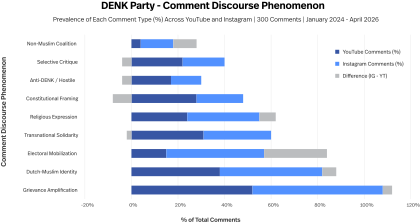
Source: Created by the authors using sources (YouTube and Instagram comments analysis @DENKnl, @denknl as the primary data).
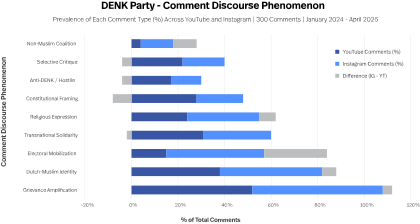
Source: Created by the authors using sources (YouTube video and Instagram comments analysis @DENKnl, @denknl as the primary data).
Of the coded comments, 61% were pro-DENK: 38% were strongly pro-DENK, expressing electoral urgency, validation of the party, or voting appeals, and 23% were generally supportive. A further 15% articulated Dutch-Muslim identity and belonging, 9% came from commenters who said they were not Muslim but agreed with DENK, and 8% were critical or mixed. Anti-DENK and hostile comments together made up about 7% (Figure 4). Figure 5 indicates that grievance amplification and Dutch-Muslim identity were the most prevalent discourse types, that electoral mobilisation appeared considerably more often in Instagram than in YouTube comments, and that transnational solidarity appeared at similar levels on both platforms. The comment patterns mirror the coding of the posts themselves: grievance mobilisation was the most frequent code in the posts (14 of 19), and transnational solidarity appeared at similar rates on both platforms (three of seven YouTube videos and four of twelve Instagram posts; see Section 5.1). These shares describe what active commenters expressed beneath the selected posts. They do not show the views of DENK’s wider audience or voters, and they should be read alongside the limitations of the sampling described in Section 4.
The 2025 Election Campaign
For DENK, the October 2025 general election genuinely tested the structural integrity of the Digital Virtual Pillar (IFES Election Guide, 2025). The entire campaign was dominated by immigration, integration, and Gaza, the three issues on which DENK’s community is most targeted by hostile political rhetoric. Wilders campaigned explicitly on anti-Muslim themes, including renewed calls for mosque closures and Quran restrictions. In this environment, DENK’s digital strategy appears to have moved into a more confrontational mode. Rather than adopting a defensive posture, party leaders staged direct, high-visibility parliamentary confrontations with Wilders and right-wing peers, presumably anticipating that these confrontations would be clipped and circulated as evidence that DENK was actively ‘fighting back’ on behalf of its community.
The electoral data are consistent with, but do not by themselves demonstrate, the effectiveness of this strategy. The highest-engagement Instagram post in the entire dataset, Stephan van Baarle challenging Wilders directly, receiving 17,500 likes, was generated during the election campaign. Community commenters responded with statements including: ‘Wilders IS the problem in the Netherlands, DENK is the solution,’ and in one of the dataset’s most analytically revealing comments, ‘there are one million Muslims in the Netherlands; we should give at least ten seats to DENK.’ This aspirational comment reveals the gap between demographic weight and political representation that may sustain DENK’s mobilisation logic independently of actual electoral outcomes: as long as the community perceives its parliamentary representation as unjustly below its demographic weight, DENK’s Digital Virtual Pillar provides the organising framework for continued mobilisation.
This interpretation is not the only one available from the same data, and there are three alternatives to consider before advancing it. First, DENK’s stable three-seat performance could reflect not digital mobilisation but stable low turnout: Muslim electoral participation in the Netherlands lags the national average substantially, so a stable vote share is as consistent with a stable, non-expanding base as with successful mobilisation of new supporters (Kollar, Geurts and Spierings, 2024). Second, the hostile climate as described was not produced by the PVV alone; JA21, FvD, and BBB also competed for anti-immigration and anti-Islam positioning over this period, so the rhetorical environment DENK responds to cannot be attributed to a single competitor. Third, part of this hostility may itself be downstream of contagion effects, whereby mainstream parties adopt more restrictive positions in response to radical right electoral success (Van Spanje, 2010), rather than a static backdrop against which DENK’s strategy operates independently. Currently, the retention of three seats is consistent with the argument that DENK’s digital strategy was effective, but it does not, by itself, prove that the strategy caused this electoral outcome. Survey or panel data would be needed to determine whether DENK’s digital campaigning actually influenced voters, a limitation that should be acknowledged in the conclusion.
DENK’s aggregate national vote share of approximately 2% understates its political significance in specific geographical contexts. City- and district-level data from the 2023 and 2025 elections reveal the depth of urban concentration with a precision that transforms the analytical picture entirely. In Rotterdam, historically a PVV stronghold, DENK received 10.4% of the total city vote in 2025, up from 9.9% in 2023, making it the fourth-largest party in a major Dutch city despite being the fourteenth-largest nationally (NL Times, 2025). In Amsterdam, DENK secured 7.7% of the city’s vote. In The Hague, it secured 8.7%. These urban figures are three to five times the national average, suggesting that DENK’s Digital Virtual Pillar is not a dispersed national phenomenon but a geographically dense urban infrastructure (Kiesraad – verkiezingsuitslagen, n.d.-b).
The district-level data are even more striking. In some majority-minority neighbourhoods, such as Kanaleneiland-Noord in Utrecht, DENK secured nearly 40% of the vote in the 2025 Dutch parliamentary election (Buurtcijfers, 2025). Across Amsterdam’s Nieuw-West district as a whole, DENK received 22.5% of the vote, approximately 9.5 times its national share of 2.37% in the same election (DE Westkrant, 2025; Kiesraad, 2025). These figures are consistent with the reading that DENK’s digital strategy is not broadcasting to a dispersed national audience; it may be helping to construct dense, geographically concentrated communities of engagement in the specific urban spaces where Dutch Muslim youth live, work, and experience the daily realities that DENK’s content addresses.
The urban concentration effect may be related to DENK’s dual mobilisation approach, although the residential concentration of potential supporters is an equally plausible driver and the present data cannot establish a causal link. Social media content combines global Islamic solidarity with hyperlocal grievances calibrated precisely to urban Muslim youth: housing discrimination, school prayer restrictions, and institutional racism in government offices (Van der Valk, 2020). The digital platform collapses the distance between the personal and the political: a follower in Kanaleneiland who watches DENK’s Instagram may not experience the party as an abstract national political entity; they may experience it as a voice that understands their street, their school, and their daily experience of contested belonging.
Conceptual contribution
The Dual Mobilisation Strategy
This framework was developed abductively: its two registers (an identity register and a grievance register) were first anticipated from the theoretical integration above, then inductively refined and evidenced through the coding of the empirical corpus described in the Methodology section and presented in the Findings section.
By integrating the theoretical frameworks discussed above with the empirical findings of the digital ethnography, this study develops the dual mobilisation strategy as an original conceptual framework to explain DENK’s digital political communication. The strategy operates on two simultaneous registers that together constitute a proposed mechanism through which digital Islam may be converted into electoral support.
On the first register, DENK deploys symbols and vocabulary of Islamic identity: the Palestinian flag, Arabic greetings, Turkish-language content, references to global Muslim solidarity, and Eid celebrations, to create emotional resonance with Muslim youth who feel culturally invisible in mainstream Dutch politics. As discussed in the Findings section, these should not be understood as a single homogeneous category of “Islamic Symbols” but rather as overlapping Islamic, ethnic, and diasporic identity markers whose political meanings vary across contexts. This identity register functions as a trust infrastructure: it establishes DENK as ‘one of us’ in a media environment where Muslim voices are routinely marginalised or pathologised. The trust established through identity signalling is not merely effective; it is political. When young Dutch-Moroccan citizens observe DENK leaders wearing Palestinian flag badges during debates in the Tweede Kamer der Staten-Generaal (Second Chamber of the States General of the Netherlands), they are witnessing more than a symbolic cultural gesture; they are seeing elements of their own identity publicly represented and defended within the Netherlands’ highest democratic institution by elected officials who share their cultural and political vocabulary (Cesari, 2013).
On the second register, DENK translates this emotional community trust into concrete electoral mobilisation by addressing material grievances: unemployment, housing discrimination, police profiling, school prayer bans, and institutional racism (Vermeulen et al., 2020). These issues are framed not as abstract policy matters but as personal, visceral, and shared experiences, a communication style that resonates powerfully with youth audiences accustomed to the personal register of social media. The grievance register provides the material rationale for voting: not merely cultural recognition but substantive policy change that directly affects daily life. The two registers are conceptualised here as interdependent and mutually reinforcing: identity signalling creates a community of trust within which grievance politics becomes credible, and grievance politics provides the material motivation that transforms cultural identification into the act of voting.
The articulation of both registers through digital platforms, where virality, speed, and intimacy collapse the distance between global Islamic solidarity and local Dutch grievances, can be read as DENK’s most significant political innovation. This combination is visible in the corpus: ten of the 19 analysed posts pair the identity register (Codes A or C) with the grievance register (Code B), five as A+B and five as B+C (Table 2). Traditional minority parties were forced to choose between identity politics and issue-based politics, fearing that identity-first communication would alienate mainstream voters, while issue-first communication would fail to build community loyalty (Loader and Mercea, 2011). DENK's digital infrastructure allows it to pursue both simultaneously in real time, with measurable engagement metrics that allow for continuous strategic refinement. Together, these two registers construct what this paper terms the Digital Virtual Pillar: a non-territorial, digitally maintained political infrastructure that performs the social coordination function provided once by physical Pillarisation, supplying community identity, political voice, and electoral solidarity to a minority that the post-pillarised Dutch system left without institutional representation.
The Digital Virtual Pillar
The Digital Virtual Pillar is the paper’s second concept. It refers to the set of digital assets and practices through which DENK performs online some of the functions that the physical pillars of Dutch pillarisation once performed for their members (Lijphart, 1975). Empirically, in this study it comprises (a) DENK’s official YouTube and Instagram accounts, (b) the accounts of its leaders, (c) the videos and clips circulated across platforms, and (d) the comment spaces and audiences that form around them. Analytically, it is defined by three functions: identity, through the trust infrastructure built by identity signalling; voice, through the grievance register that turns everyday experiences into political claims; and coordination, through electoral cues, the visibility of leaders, and the consolidation of a community around the party. It is virtual because it is non-territorial and is maintained through platform interaction, not through physical institutions such as schools, unions, or broadcasters. It is a pillar in the sense that it offers a minority a semi-autonomous space of communication and solidarity that is linked to political representation.
The Digital Virtual Pillar differs from historical pillars in important ways: it has no formal membership, owns no institutions, depends on commercial platforms and their algorithms, and does not enclose its audience. It builds on Fraser’s (1990) counter-public but adds the electoral and organisational link between a digital counter-public and a parliamentary party. Because this study analyses public content and comments, not audience behaviour or votes, the concept is offered as an interpretive tool, and its capacity to sustain electoral support remains a hypothesis for further testing. A related notion, post-Islamist digital civic mobilisation, is inspired by Bayat (2013). It describes forms of Muslim democratic participation that cannot be reduced to either secularised assimilation or religious radicalism: the assertion of civic identities informed by religion and culture through the institutions, languages, and participatory practices of liberal democracy.
Conclusion
DENK’s political success in the Netherlands is best understood as a sophisticated instance of digitally mediated minority politics. Through a dual mobilisation strategy that combines Islamic identity signalling with local grievance politics, DENK has constructed what this paper conceptualises as the Digital Virtual Pillar, which is interpreted as providing Dutch Muslim youth with identity, voice, and collective electoral agency in a political environment that has systematically denied them all three.
The digital ethnography of 19 purposively selected posts across YouTube and Instagram between January 2024 and April 2026, supplemented by 300 audience comments and by district-level electoral data, provides the empirical basis for this study. The electoral data reveal DENK's 30–40% vote shares in specific majority-minority urban neighbourhoods, figures that transform the analytical significance of a party conventionally described as ‘small’ based on its 2% national average (Kiesraad – verkiezingsuitslagen, n.d.-a; Otjes and Krouwel, 2019).
The implications of this study extend beyond the Netherlands. As European democracies continue to grapple with the political integration of their largest religious minority against the backdrop of sustained right-wing populist pressure, the DENK model suggests that digital platforms have altered the terms under which minority political participation is possible. The question is no longer whether Muslim youth will integrate into existing political structures but on which terms they will participate. Increasingly, these terms are being set in the comment sections of Instagram, in the viral clips of parliamentary confrontations, and in the multilingual digital spaces where a new European Muslim political identity is being forged, tested, and electorally expressed.
Future research should pursue the following three principal directions. First, longitudinal studies could track DENK’s digital engagement across the 2025–2029 electoral cycle, particularly as regulatory pressures on social media platforms intensify. Second, comparative digital ethnographies of the Democratic Alliance for Diversity and Awakening (DAVA), NIDA, and French Muslim digital communities could examine whether the transnational Muslim digital public sphere operates as a unified formation or as a series of distinct national counter-publics. Third, survey-based research among Dutch Muslim youth voters could quantitatively test the relationship between social media exposure and electoral participation, thereby strengthening the causal claims explored in this article.