 https://orcid.org/0009-0003-5946-9022
Introduction
Debates on minority inclusion in Central and Eastern Europe frequently centre on the Roma, who remain among the most marginalised and discriminated ethnic minorities in Europe (McGarry, 2012). Roma are often referred to as the biggest minority in Europe, facing racism, discrimination, and exclusion on a daily basis (Iusmen, 2018), considered the most vulnerable minority of today (Kosa & Adany, 2007), or as a “disadvantaged population at risk of discrimination in all spheres of life” (Surdu & Kovats, 2015, p. 6).
Existing research shows that Roma in Slovakia are frequently constructed through stereotypes of welfare dependency, criminality, unwillingness to work, and social maladjustment (Mušinka & Kolesárová, 2012; Miškolsci et al., 2020). Negative constructions and discrimination towards Roma are so widespread – not only in society but among politicians or healthcare professionals as well – that Roma have had to adjust their lifestyle to being discriminated against. They had to get used to living in underdeveloped regions, which are less accessible and out of the authorities´ reach and sight, and they tend to be concentrated in bigger groups (sometimes referred to as cohabitations) because they feel safer than being on their own (Ciaian & Kancs, 2018).
Discrimination and negative perceptions of the Roma minority are difficult to track as they have deep historical roots (Mušinka & Kolesárová, 2012); thus, this is not a new and unknown problem. Nonetheless, policies aiming to improve the situation of Roma have had a limited success and effect; progress has been limited and social conditions have not improved in the past two decades (Fésus et al., 2012). As Fésus et al. (2012) state, one of the biggest disadvantages, alongside limited social and political support, is the short-term nature of Roma inclusion projects and initiatives, meaning that even projects which are starting to show some results and seem to be effective do not last enough to make real changes and improvements. At the same time, no Roma inclusion policy will ever be successful without combating discrimination, racism and society´s negative framings of Roma (Fésus et al., 2012). However, in today´s European society, the opposite can be observed: according to Huub van Baar, there is an ongoing increase “of anti-Roma voices” (2011, p. 205) in Europe, in some cases even among decision-makers in Brussels. He described this phenomenon as “reasonable anti-Gypsyism” (van Baar, 2011, p. 204), referring to political leaders legitimising Roma discrimination, segregation, and marginalization in order to achieve a successful and prosperous society, connecting it with critiques of liberal multiculturalism which are, by some, perceived as threats to today´s world as well as posing a way of how to approach potential electorates (van Baar, 2011).
Negative discourse related to the Roma minority is not uncommon even on the political level. In their article, Miškolci et al. (2020) argued that politicians tend to use hate speech to produce fear and create a specific, desired view of Roma. They added that the fear of losing their authority is one of the most common triggers for this kind of hate speech. They use it as a kind of social control, while trying to persuade people about what should be acceptable, normal, while gaining or maintaining their power again (Miškolci et al., 2020). Such anti-Roma discourse is not limited to Slovakia, but Slovakia represents a particularly relevant case because Roma exclusion has remained a persistent issue across the entire post-1993 period. Despite that, hate speech towards Roma is under-researched. The majority of such research has been done in English and about different (ethnic) groups. Although existing studies have examined anti-Roma attitudes, hate speech, and selected forms of public discourse in Slovakia, less attention has been paid to the long-term development of official parliamentary discourse on Roma across the post-1993 period (Miškolci et al., 2020).
Therefore, this article analyses Slovak parliamentary discourse on the Roma minority between 1993 and 2023. It focuses on debates in the National Council of the Slovak Republic as a specific institutional arena where Roma-related issues were publicly named, linked to policy agendas, and evaluated. The article, therefore, does not treat parliamentary discourse as identical with political discourse as a whole. Rather, it examines the parliament as one important site of political meaning-making. Using a longitudinal corpus of parliamentary transcripts, the study first maps the frequency of Roma-related references across parliamentary terms and then interprets the recurring frames through which Roma were constructed as objects of threat, assistance, social problems, equality, or technocratic policy. Parliamentary discourse matters, because it participates in defining Roma as a target policy group (Schneider & Ingram, 1993), and in legitimising particular forms of inclusion, exclusion, responsibility, or state intervention. Rather than inferring politicians’ private attitudes, this article analyses how political actors have publicly constructed Roma in parliamentary speech. Analysing these constructions can clarify how Roma inclusion was made politically visible, marginal, urgent, or controversial within the Slovak parliamentary debate. The article contributes to research on Roma inclusion, anti-Gypsyism, and minority politics by providing a longitudinal analysis of how Roma were constructed in Slovak parliamentary debates across the first thirty years of Slovakia’s independence, while its contribution is both empirical and analytical. Empirically, it traces when Roma-related issues became more or less visible in parliament. Analytically, it shows how inclusion-oriented language coexisted with older exclusionary, paternalistic and technocratic framings, suggesting that parliamentary discourse on Roma inclusion changed through layering rather than through straightforward transformation.
Throughout the article, three research questions are answered:
How was the Roma minority constructed in Slovak parliamentary discourse between 1993 and 2023?
Which recurring discourse frames structured parliamentary debate about Roma inclusion, exclusion, and responsibility?
How did the frequency and framing of Roma-related parliamentary discourse vary across parliamentary terms and major political or institutional contexts?
The analysis is informed by discursive institutionalism, which treats discourse as a medium through which political actors construct, contest and legitimise policy meanings within institutions (Schmidt, 2008). The ‘garbage can’ model (Cohen et al., 1972) is used more narrowly to interpret shifts in parliamentary attention to Roma-related issues, especially as to why some issues enter or leave the parliamentary agenda at particular moments. The analysis of political discourse uses content analysis of publicly available discourse from meetings of the National Council of the Slovak Republic, which can be found in the e-archive of the Joint Czech and Slovak Digital Parliamentary Library.1
The article proceeds as follows. First, it outlines the social and political context of Roma exclusion in Slovakia and reviews relevant literature on anti-Gypsyism, Roma-related discourse, and minority politics. Second, it presents the theoretical framework and explains how discursive institutionalism and agenda-setting perspectives inform the analysis. Third, it describes the corpus, the search strategy, the unit of analysis and the coding procedure. The empirical section then combines a descriptive mapping of Roma-related discursive frames and selected periods of heightened parliamentary attention.
Roma exclusion and inclusion in Slovakia
The Roma minority represents one of the most marginalised groups in Slovakia. Its exact size is difficult to determine, partly because many Roma do not declare their ethnic identity in official censuses. This reluctance is often connected to experiences or expectations of stigmatisation, discrimination, and racism, as well as to negative public perceptions of Roma identity (Klimovský et al., 2016). According to the Atlas of Roma Communities, approximately 450,000 Roma lived in Slovakia in 2019, representing around 7.6% of the population (Ravasz et al., 2020).
The Atlas also shows the internal diversity of Roma living conditions in Slovakia. While approximately 56,000 Roma lived in segregated settlements, often located outside municipalities, around 117,000 Roma lived integrated with the majority population (Ravasz et al., 2020). Yet public and political debates often reduce Roma to marginalised settlements, poverty, and social exclusion. Such a reduction obscures the heterogeneity of Roma experiences and may reinforce the perception of Roma as an exceptional or problematic population. Although some indicators of living conditions improved between 2004 and 2019, these improvements remained limited and uneven (Ravasz et al., 2020; Rafael, 2020).
Exclusion is also reproduced through unequal access to public services. Roma in Slovakia continue to face barriers in health care, employment, and education, while Roma children have repeatedly been placed in segregated schools, special classes, or corrective educational tracks rather than receiving adequate support within mainstream education (Powell & Lever, 2017). These practices matter not only as policy failures, but also as part of the broader institutional context in which Roma are constructed as deficient, maladapted, or in need of correction.
Police violence has also formed an important part of the Slovak context of Roma exclusion. One of the most visible cases was the 2013 police intervention in Moldava nad Bodvou, later discussed before the European Court of Human Rights (Policajná Razia, 2013). The case became symbolically important because it connected Roma marginalisation with the question of state violence, institutional accountability, and unequal treatment. It also entered parliamentary debate, where Roma were constructed either as victims of institutional violence or, in opposing frames, as a population associated with criminality and disorder.
The Slovak case, therefore, illustrates that Roma inclusion is not only a question of policy design, but also a question of meaning-making. Formal inclusion policies, strategies, and equality commitments coexist with persistent constructions of Roma as poor, dependent, criminalised, or administratively problematic. This tension corresponds with what Kóczé and Rövid (2017, page 690) describe as a “double discourse” of Roma inclusion, in which formal commitments to rights and integration coexist with racialised, paternalistic or conditional understandings of Roma citizenship.
Public and political discourse on Roma in Slovakia
Although this article analyses parliamentary discourse, public discourse on Roma in Slovakia forms an important contextual background. Public, political, and parliamentary discourse should not be treated as identical, but they are connected. Public attitudes may shape what political actors consider electorally acceptable, while political actors may reproduce, legitimise, or contest dominant public meanings. In such a sense, discourse contributes to the social constructions of Roma as a policy target group and affects which policy responses appear legitimate or necessary (Schneider & Ingram, 1993).
Recent public opinion data confirm that negative attitudes towards Roma remain widespread in Slovakia. A representative survey conducted in December 2024 for the Office of the Government Plenipotentiary of the Slovak Republic for Roma Communities found that 33% of respondents held negative attitudes towards Roma, while only 5% expressed positive attitudes and 61% declared mostly neutral attitudes (Úrad splnomocnenca vlády SR pro rómske komunity, 2025). These findings do not explain parliamentary discourse directly, but they show the broader social environment in which parliamentary actors speak about Roma.
Research on online discourse also shows how openly hostile anti-Roma meanings circulate in Slovakia. Analysing Slovak Facebook discussions about Roma, Miškolci et al. (2020) found highly extremist comments, including support for violence, deportation, and the relativisation of the Roma Holocaust. Such findings show that anti-Roma discourse is not limited to formal politics. At the same time, their research also suggests that pro-Roma intervention in online discussions may open space for contestation, which is important for understanding discourse not only as a reproduction of prejudice but also as a possible site of challenge and resistance (Miškolci et al., 2020).
The broader literature on discourse about Roma shows that anti-Roma meanings are also often expressed through apparently reasonable, moralising, or paternalistic language. Tileagă (2005) describes how talk about Roma can legitimise blame and extreme prejudice while presenting exclusionary claims as common sense. Similarly, Kende et al. (2023) distinguish between paternalistic and ally political discourse, showing that apparently supportive pro-Roma discourse may still position Roma primarily as vulnerable and dependent. These insights justify moving beyond a simple distinction between positive and negative discourse.
For this reason, parliamentary discourse deserves analytical attention as one institutionalised form of political meaning-making. Parliamentary debates do not represent public discourse, nor do they directly determine public attitudes. However, they make visible how elected political actors define Roma-related problems, assign responsibility, and legitimise forms of inclusion, control, or neglect. The following analysis, therefore, focuses on parliamentary discourse, not as a mirror of society, but as a formal political arena in which the meaning of Roma inclusion is repeatedly constructed and contested.
Theoretical background: institutions, discourse, and agenda attention
In this article, discourse is understood not simply as a language, opinion, or communication. It is understood as a structured form of meaning-making through which political actors define social problems, construct policy target groups, assign responsibility, and legitimise particular form of action or inaction. Parliamentary discourse is therefore treated here as an institutional practice. It takes place within the formal rules of parliamentary debate, while also contributing to the production and contestation of public meanings. This distinction is crucial, because this article analyses how Roma have been publicly constructed within parliamentary speech.
This understanding of discourse is closely related to Schneider and Ingram’s theory of the social construction of target populations. Schneider and Ingram (1993) argue that policy target groups are not only administratively defined, but also socially constructed through normative and political meanings. These constructions shape whether groups are perceived as deserving or undeserving, powerless or powerful, and whether policy interventions aimed at them are perceived as legitimate. In the case of Roma inclusion, parliamentary discourse can therefore construct Roma as equal citizens, as vulnerable subjects requiring support, a social problem, a threat, or just a routine administrative category. Such constructions are politically relevant, because they influence which policy responses become conceivable, acceptable, or urgent within institutional debate.
The article’s main theoretical framework is discursive institutionalism. Discursive institutionalism emerged as one of the newer institutionalist approaches, complementing earlier historical, rational choice, and sociological institutionalisms (Hall & Taylor, 1996; Schmidt, 2008; Schmidt, 2010). Its central contribution is its emphasis on ideas and discourse in explaining institutional continuity and change. For Schmidt (2008; 2010), institutions are not only external structures that constrain actors, but also meaning contexts that are interpreted, reproduced, and contested through discourse. Political actors use discourse to communicate ideas, justify policy decisions, challenge dominant norms, and legitimise institutional arrangements.
In the context of this article, discursive institutionalism helps explain why parliamentary statements about Roma matter. They also contribute to constructing what kind of policy problem Roma inclusion is, who is considered responsible, and which responses appear legitimate. A statement constructing Roma primarily as equal citizens implies a different policy logic than a statement constructing Roma as criminals, welfare abusers, passive recipients of help, or technocratic policy category.
This framework is further strengthened by the concept of ideational power (Carstensen & Schmidt, 2016). It refers to the capacity of actors to influence other actors’ normative and cognitive beliefs through ideas. Carstensen and Schmidt (2016) distinguish between power through ideas, power over ideas, and power in ideas – persuasion through ideas, control over which ideas are considered legitimate, and the deeper institutionalisation of certain assumptions as common sense. This concept is useful for analysing parliamentary discourse on Roma, because it directs attention to how certain assumptions about Roma become normalised within institutional debate. It allows going beyond the positive, negative, and neutral categorisation of statements.
Therefore, this article does not assume that discursive change automatically produces institutional transformation. Rather, parliamentary discourse is treated as one part of a broader institutional field in which older and newer meanings may coexist. It supports the interpretation of the central pattern examined in the article, that inclusion-oriented language became more visible over time, particularly in relation to EU accession and Roma inclusion strategies, but it still often coexisted with older exclusionary, technocratic, and paternalistic constructions. This pattern can be understood as discursive layering rather than straightforward transformation.
This framework is also informed by research on anti-Roma discourse and the politics of Roma inclusion. Tileagă (2005) demonstrate how discourse on Roma can construct them as responsible for social problems, reinforce deeply prejudicial views, and frame exclusionary positions as legitimate or acceptable. Kóczé and Rövid (2017) describe the politics of double discourse in contemporary Europe, where formal commitments to Roma inclusion coexist with racialised, neoliberal, or paternalistic constructions of Roma as deficient, dependent, or responsible for their own exclusion. These studies show why apparently inclusion-oriented parliamentary statements cannot automatically be interpreted as emancipatory. Appeals to help Roma, for example, may challenge exclusionary discourse, but they may also construct Roma as passive recipients of assistance. Kende et al. (2023) support this caution by showing that both paternalistic and ally discourses can predict pro-Roma solidarity intentions, but they differ in how Roma are positioned. Paternalistic discourse may mobilise support while still constructing Roma as vulnerable and dependent, whereas ally discourse is more likely to emphasise equality, shared responsibility, and moral inclusion.
The second theoretical tool used in the article is the ‘garbage can’ model (Cohen et al., 1972). This model is used narrowly to interpret variation in parliamentary attention to Roma-related issues. Cohen et al. (1972) describe decision-making in organised anarchies as shaped by the shifting of problems, solutions, participants, and choice opportunities. In this article, the model helps interpret why Roma-related issues became more visible in some parliamentary terms and less visible in others. Periods of EU accession, the development of the Roma inclusion strategy, police violence, extremist party representation, or COVID-19 created different opportunities for Roma-related issues to enter parliamentary debate. Conversely, government crises or competing policy priorities may have displaced Roma inclusion from sustained parliamentary attention.
Together, these perspectives guide the analysis in two ways. Discursive institutionalism, ideational power, and Roma-focused discourse scholarship inform the interpretation of how Roma were constructed in parliamentary speech and how these constructions legitimised or contested policy meanings. The garbage can model informs the descriptive mapping of parliamentary attention by helping to interpret why Roma-related issues have appeared more frequently in some periods than in others. The analysis therefore distinguishes between two related questions: how often Roma were made visible in parliamentary debate, and through which frames this visibility was politically organised.
Data and methods
This article uses a two-stage qualitative design to analyse how Roma were publicly constructed in official Slovak parliamentary discourse. First, qualitative content analysis was used to identify and map Roma-related references in official Slovak parliamentary transcripts across parliamentary terms. The first stage draws on qualitative content analysis (QCA), understood as a systematic yet interpretive approach to textual data that enables the identification, coding and categorisation of meaning patterns in context (Hsieh & Shannon, 2005; Mayring, 2014; Krippendorff, 2018). This stage provided a descriptive overview of the frequency and initial evaluative orientation of Roma-related discourse.
In the second stage, the coded material was re-examined interpretively in order to identify recurring discursive frames through which Roma were constructed as a threat, a social problem, vulnerable subjects requiring assistance, equal citizens, or objects of administrative and technocratic policy. The design, therefore, combines systematic mapping with interpretative frame analysis. This is appropriate for the article’s aim to analyse how Roma were publicly constructed in parliamentary speech. The article can be understood as a longitudinal single-country study of parliamentary discourse. The corpus consists of publicly available transcripts of official meetings of the National Council of the Slovak Republic from the post-1993 period until September 2023. The transcripts were accessed through the Joint Czech and Slovak Digital Parliamentary Library. The analysis focuses only on official parliamentary speech delivered during National Council meetings. It does not include campaign statements, media interviews, party press releases, social media communication, local-level political discourse, or other statements made by political actors outside parliament. This limitation is important because parliamentary discourse represents only one institutional arena of political meaning-making, rather than political discourse as a whole. Although the article examines the post-1993 period of Slovak independence, the empirical section is organised by parliamentary terms. The coded material starts with the first post-1993 parliamentary term, thus the term 1994-1998.
Relevant material was identified through keyword searches in the Slovak-language transcripts. The search included Slovak equivalents and grammatical variants of words ‘Roma’, ‘Romani’, and ‘Gypsy’ (in Slovak: ‘Róm’; ‘Rómovia’; ‘Cigán’). Each search result was read in context to determine whether it referred to Roma as an ethnic minority, Roma communities, Roma-related policy, or anti-Roma discourse. Irrelevant mentions, such as purely technical occurrences, were excluded. Relevant excerpts were recorded in an Excel file together with information on the parliamentary term, date, speaker, party affiliation, code, subcode, and analytical notes.
A discursive unit was defined as a thematically coherent statement by one speaker in which Roma, Romani people, or related ethnonyms were connected to a policy issue, social evaluation, institutional practice, political argument, or moral judgement. A unit could consist of one sentence or several adjacent sentences when the meaning depended on the surrounding context. If one parliamentary speech contained several distinct Roma-related arguments, these were coded as separate units. If several mentions of Roma appeared within the same argument, they were treated as one unit rather than counted separately. A statement was included when Roma were explicitly mentioned and when the surrounding speech provided enough context to identify the reference’s function. Statements were excluded when the occurrence resulted from technical or archival repetition.
The coding proceeded in two stages. In the first stage, each discursive unit was coded descriptively according to its initial evaluative orientation, into three categories: positive, negative and neutral (or administrative). This first coding cycle was used to map broad changes in the visibility and orientation of Roma-related parliamentary discourse across parliamentary terms. At this stage, more specific subcodes were also developed inductively, including references to criminality, welfare dependency, equality, violence, help, and social exclusion.
These subcodes were re-examined in the second stage and consolidated into broader interpretive frames. This step moved the analysis beyond positive/negative/neutral distinction and focused on meaning-making; in a sense, how Roma were constructed, what responsibilities were assigned, and which assumptions about Roma were reproduced and contested. The broader frames were developed through repeated reading, comparison across parliamentary terms, and analytical memo-writing. This stage was informed by Braun and Clarke’s reflexive approach to thematic analysis, particularly their emphasis on repeated engagement with the material, researcher reflexivity, and the development of the themes as interpretive patterns rather than mechanically extracted categories (Braun & Clarke, 2019).
Ambiguous cases were not coded solely on the basis of individual words; they were interpreted based on surrounding parliamentary speech. For example, a statement calling for ‘help’ for Roma was not automatically coded as inclusionary, but was examined in its whole context. When a statement could plausibly fit more than one subcode, the dominant function of the statement in the parliamentary argument was coded, while secondary meanings were recorded in analytical notes.
Because the study is based on single-researcher interpretive coding, it does not aim to establish statistical inter-coder reliability. Credibility was strengthened through transparency of the coding procedure, repeated reading of the material, systematic comparison of statements across parliamentary terms, and the documentation of coding decisions in analytic notes. The coding scheme was revised as new patterns appeared, and earlier material was revisited after the main interpretive frames had been stabilised.
The analysis is interpretative and therefore shaped by the researcher’s analytical decisions. To reduce the risk of arbitrary categorisation, coding decisions were documented and categories were refined through repeated comparison across periods. The study also has some methodological limitations. First, the search-term strategy captures explicit references to Roma, but it may have missed implicit anti-Roma discourse in which Roma were not mentioned directly. Second, the corpus is limited to official parliamentary meetings and therefore cannot represent political discourse outside the National Council. Third, quotations from Slovak parliamentary speeches were translated by the author; the analysis therefore prioritises the meaning and function of the statement rather than its literal linguistic equivalence.
Findings
The analysis identified 1,671 Roma-related discursive units in official Slovak parliamentary transcripts. These units were firstly coded according to their initial evaluative orientation as positive, negative, or administrative/neutral. This first stage of coding provides a descriptive overview of how visible Roma-related issues were across parliamentary terms and how these references were broadly oriented. However, these categories are not treated as final discursive categories. They rather serve as an entry point for the second stage of analysis, which interprets how Roma were constructed through broader parliamentary frames.
Descriptive overview: parliamentary attention and initial coding
The empirical material is organised by parliamentary terms. Although the article addresses the post-1993 period of Slovak independence, the coded material begins with the first post-1993 parliamentary term, 1994-1998, and continues until September 2023. Across these eight parliamentary terms, the number of Roma-related discursive units varied considerably. This variation is analytically important because it shows when Roma-related issues became more or less visible in parliamentary debate.
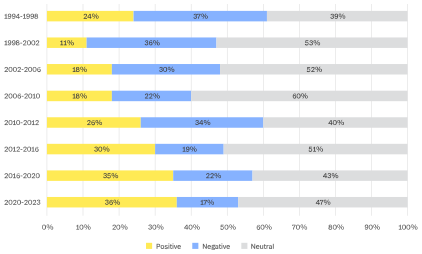
Figure 1 presents the distribution of the three initial coding categories across parliamentary terms. Administrative/neutral references were the most frequent overall, representing 49% of the coded material. Positive references accounted for 28%, while negative references accounted for 23%. These percentages should not be read as evidence that parliamentary discourse was predominantly inclusive or non-conflictual. Rather, they show the first descriptive layer of the corpus and indicate the need for closer interpretation of what these categories actually contained.
The predominance of administrative/neutral references does not mean that these references were politically irrelevant. In many cases, Roma appeared as a demographic, legal, procedural, or policy category – for example, in references to minority lists, government reports, strategies, or administrative documents. Such references may lack explicit emotional evaluation, but they still contribute to a technocratic mode of parliamentary discourse in which Roma inclusion is framed primarily as an administrative issue.
Source: The author
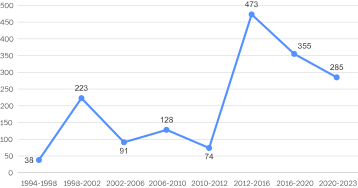
Figure 2 shows that parliamentary attention to Roma-related issues fluctuated substantially across the analysed period. The first analysed term, 1994-1998, contained only 38 discursive units, while the number rose to 223 in 1998-2002. The highest number of references appeared in 2012-2016, with 473 units, followed by 355 units in 2016-2020 and 285 in 2020-2023. These fluctuations suggest that Roma-related issues entered parliamentary debate unevenly, often becoming more visible in periods connected to EU accession, Roma inclusion strategies, police violence, extremist party presentation, or governmental crises. These contextual patterns are discussed in more detail in the Discussion section.
Source: The author
The descriptive overview, therefore, provides only the first layer of the analysis. To understand the political meaning of parliamentary discourse on Roma, it is necessary to examine the recurring frames through which Roma were constructed. The following subsections analyse these frames in more detail: criminalisation and securitisation; Roma as social burden and conditional citizens; paternalistic assistance and vulnerability; equal citizenship and anti-racist contestation; and administrative or technocratic discourse.
Criminalisation and securitisation
One of the most persistent frames in Slovak parliamentary discourse was the construction of Roma as a threat to public order. The frame appeared most clearly in statements that linked Roma to criminality, delinquency, antisocial behaviour, or danger. These statements often presented criminality as a collective characteristic of Roma communities. In this way, the discourse ethnicised and positioned Roma as a security problem. In the first cycle of coding, references to Roma as delinquents or criminals constituted the largest negative subcategory, accounting for 22% of all negative references. Importantly, this subcategory appeared in every analysed parliamentary term, which suggests that criminalisation was not limited to one party, one period, or one political crisis. It represented a durable discursive pattern across the post-1993 parliamentary period.
The early post-1993 period illustrates how criminality could be explicitly ethnicised. In 1997, Róbert Fico associated serious crimes with Roma when discussing recidivism and antisocial behaviour:
Typical of the crimes of murder, robbery, assault, and rape is that they are committed primarily by recidivists – mostly Roma – unemployed antisocial elements with multiple criminal records. (Fico, 1997; translated by the author)
The statement does even more than report crime, because it connects serious offences, unemployment, recidivism, and Roma ethnicity into a single chain of association. Roma are not constructed here as citizens who may experience exclusion or unequal treatment, but as a population linked to disorder and danger. The phrase “mostly Roma” turns criminality into an ethnicised category, while the reference to “antisocial elements” removes individually and presents Roma offenders as part of a broader deviant group.
The persistence of this frame is also visible two decades later, in statements by MPs from the extreme right. In 2017, Milan Uhrík used an anecdote about theft to present Roma criminality as everyday and self-evident:
The antisocials coincidentally as gypsies, of gypsy origin, as they say, stole the gate (from the house – note of the author) from my own father, and when he caught them in the act, they said, they were holding it in their hands, of course, so they said they weren't stealing it, they were just weighing it. They're testing how heavy it is. (Uhrík, 2017; translated by the author)
Unlike the earlier statement, this example relies on anecdotal and mocking language. However, it performs a similar discursive function. Roma are associated with theft, deception, and antisocial behaviour, while the story invites the audience to treat this association as common sense. The use of “antisocials” and “gypsies” collapses social status, ethnicity and criminality into one category. The frame, therefore, constructs Roma as a group whose presence requires suspicion and control.
The criminalisation frame has a securitising function. By repeatedly linking Roma to crime, parliamentary speakers could shift Roma inclusion away from questions of equality, poverty, or discrimination and towards questions of public order, policing, and protection of the majority population. Securitising discourse narrows the range of legitimate policy responses. Instead of asking how institutions produce or reproduce exclusion, the debate becomes organised around how the state should control or discipline Roma communities. The persistence of this frame across parliamentary terms suggests that criminalisation remained one of the most durable exclusionary constructions of Roma in Slovak parliamentary discourse. Even when inclusion-oriented language became more visible in late periods, the association between Roma and criminality continued to provide vocabulary for exclusion, control, and suspicion.
Roma as a social burden and conditional citizens
A second recurring frame constructed Roma as a social burden and a problem of governability. In this frame, Roma were associated with welfare dependency, unemployment, poor hygiene, lack of education, maladaptation, or pressure on public resources. These statements did not always use openly hostile language, but they often positioned Roma as a population whose inclusion was conditional on behavioural change, discipline, or adaptation to majority norms.
This frame combined several subcategories. The category “Roma as a problem” accounted for 16% of all negative references, while “Roma as undeserving” accounted for 14%. Other related subcategories included references to Roma as welfare abusers, as people living on social benefits, as unadaptable, unemployed, uneducated, or unhygienic. Taken together, these subcategories show that negative parliamentary discourse was not limited to criminalisation. Roma were also constructed as a population that allegedly created social, administrative, and economic difficulties for the state and the non-Roma majority. The construction of Roma as conditional citizens is visible in statements that contrasted Roma ways of life with majority norms. In 2005, Ivan Gašparovič described part of the population as living outside the “customs and norms” common in Slovakia:
We must be aware that there is a significant part of the population in our country whose living and social conditions do not correspond to the customs and norms common in Slovakia. (Gašparovič, 2005; translated by the author)
The statement does not explicitly use insulting language. Its political meaning lies in the contrast between “customs and norms common in Slovakia” and a population implicitly positioned outside them. Roma are constructed as a group whose difference is normatively deficient. The problem is therefore framed less as institutional exclusion or unequal access to resources, and more as the failure of a particular population to conform to majority expectations. The same normalising logic appeared in later periods as well. In 2021, Štefan Kuffa discussed teenage pregnancy among Roma girls through the language of abnormality:
Today we are outraged by this, and especially with Roma girls, because a Roma girl, I don't know, she is 15 years old, she is pregnant or 16 years old, she is pregnant and giving birth and so on. That is not normal. (Kuffa, 2021; translated by the author)
Here, Roma girls are constructed through moral evaluation and developmental abnormality. The repeated phrase “that is not normal” turns a social and structural issue into a question of deviant behaviour. This kind of discourse individualises and culturalises inequality. Instead of focusing on poverty, segregation, reproductive health, access to education, or institutional failure, the statement frames the problem as abnormal conduct within Roma communities.
Across these examples, the frame of social burden worked through a logic of conditional citizenship. Roma were formally included as members of the Slovak polity, but their access to sympathy, assistance or recognition was made conditional on adaptation to majority norms. They appeared as citizens who had to prove that they were responsible, hygienic, working, educated, non-criminal, and deserving. This frame, therefore, differs from explicit criminalisation, but it can be equally exclusionary. Inequality is here presented as the result of Roma behaviour. The persistence of this frame shows how parliamentary discourse could reproduce exclusion even when it did not rely on overtly racist or extremist language. Speakers shifted attention away from institutional responsibility and towards the alleged deficiencies of Roma communities. This frame, therefore, helped to maintain the boundary between Roma as formal citizens and Roma as conditionally accepted members of the political community.
Paternalistic assistance and vulnerability
A third recurring frame constructed Roma as vulnerable subjects in need of assistance. This frame was most visible in statements that called for help, intervention, or greater state attention to the living conditions of Roma communities. In contrast to criminalising or burden-oriented discourse, these statements often challenged indifference, exclusion, or openly hostile claims. However, the frame is analytically ambivalent. While it can express solidarity and recognition of structural disadvantage, it may also reproduce paternalistic assumptions by positioning Roma primarily as passive recipients of help rather than as equal political actors.
“Roma need help” was the strongest positive subcategory, accounting for 41% of all positive references. Unlike some other positive subcategories, it became visible mainly from the middle of the analysed period, especially from the 2006-2010 term onwards. Its later prominence suggests that parliamentary discourse increasingly recognised Roma living conditions as requiring political attention. At the same time, the meaning of this recognition depended on how Roma were positioned within the statement, as rights-bearing citizens, as vulnerable communities facing structural exclusion, or as dependent objects of intervention.
One form of this frame appeared in debates about poverty, employment and social support. In 2010, Jana Vaľová responded to arguments about reducing support by shifting attention to the absence of employment opportunities:
Yes, I have the experience because I deal with people's problems on the ground, unlike many MPs and maybe even you. Just you know, if we take money away from them, I ask, who will give them jobs? We need to help them. (Vaľová, 2010; translated by the author)
This statement challenges a punitive or deservingness-based logic. Instead of presenting Roma poverty as the result of individual failure, it asks who will provide jobs if support is withdrawn. The appeal to “help” therefore points to a structural problem, which is the lack of realistic opportunities. At the same time, the formulation “we need to help them” still positions Roma as objects of intervention by non-Roma political actors. The statement is therefore inclusion-oriented, but it also illustrates the ambivalence of assistance discourse: it can contest blame while preserving an asymmetrical relationship between the helpers and the helped.
A similar but more explicitly rights-oriented version of the frame appeared in 2016, when Ondrej Dostál linked assistance to the findings of the governmental plenipotentiary for Roma communities and to the living conditions in Roma settlements:
If we want the situation of people living in Roma settlements to start to improve at least a little, we have to start from this side too, we have to start paying serious and intensive attention to the problems that are also described in the reports of the Public Ombudsman. Roma need help! (Dostál, 2016; translated by the author)
Here, the call for help is connected to institutional responsibility. The statement criticises the insufficient attention that public institutions pay to conditions in Roma settlements. It moves the argument closer to a rights-based frame because the problem is not located only in Roma communities themselves, but in the failure of the state to respond adequately. Nevertheless, the phrase “Roma need help” again shows the central tension of this frame. Roma are made visible through vulnerability, while their own agency remains less visible. This ambivalence corresponds to the distinction between paternalistic and ally discourse identified by Kende et al. (2023). Paternalistic discourse may express sympathy and mobilise support, but it can also construct Roma as vulnerable or dependent. Ally discourse is more likely to emphasise equality, shared responsibility and institutional accountability. The parliamentary statements challenged openly negative constructions of Roma, but they did not always fully escape hierarchical assumptions about who speaks, who helps, and who is helped.
In this frame, inclusion was articulated through the language of rights, participation or shared political agency. This is why the frame is central to the article’s broader argument that inclusion-oriented rhetoric became more visible, but it often remained layered with paternalistic constructions.
Equal citizenship and anti-racist contestation
A fourth frame constructed Roma as equal citizens and legitimate members of the Slovak population. This frame appeared in statements that rejected ethnic hierarchy, challenged collective blame, condemned violence, or insisted that Roma should be treated according to the same standards of citizenship as other groups. Compared with the previous frame, this discourse placed greater emphasis on equality, rights, and institutional accountability.
References to Roma as deserving equality accounted for 16% of all positive references, while condemnations of violence accounted for 18%. Although these subcategories were less frequent than the broader “Roma need help” category, they are analytically important because they offered a different construction of Roma. Roma were not represented only as people in need, but as members of society whose exclusion, discrimination or mistreatment required a political response.
The frame of equal citizenship is visible in statements that explicitly include Roma within the category of Slovak citizenship. In 2008, Pavol Paška rejected distinctions based on ethnicity and framed Roma as part of the wider citizenry:
Ladies and gentlemen, let us say a resolute no to this, but let us distinguish what a citizen of Slovakia is, and it does not matter whether he is Slovak, whether he is Hungarian, whether he is Roma, whether he is Ruthenian, whether he is German, whether he is Czech, and let us listen to what is bothering him because otherwise the prosperity of this country cannot go forward. (Paška, 2008; translated by the author)
This statement constructs Roma as one of several legitimate groups within the Slovak polity. Its political meaning lies in the refusal to make citizenship conditional on ethnicity. The speaker places Roma within a plural understanding of national belonging. A related form of this frame appeared in statements that explicitly rejected collective criminalisation. Such statements challenged the assumption that Roma ethnicity could be used as a shortcut for explaining criminality or social disorder. Speakers contested the criminalisation frame mentioned above, by separating individual responsibility from ethnic belonging and restoring Roma to the position of citizens rather than collective suspects.
The same frame also appeared in statements condemning violence against Roma. In 2010, László Szigeti referred to a case of police violence against Roma in Košice:
Another case. On 21 March, police officers in Košice tortured Roma boys and filmed the whole thing on their mobile phones. Fortunately, all the policemen who participated in the torture had to leave the police force. The case shocked even the opposition members of the Parliamentary Committee on Defence and Security. (Szigeti, 2010; translated by the author)
This statement constructs Roma as victims of institutional violence. The reference to the police officers shifts responsibility from Roma communities to state institutions. The problem is no longer Roma behaviour, but the abuse of power by authorities. In this way, the statement contests the security-oriented frame, as it asks how state power should be held accountable when it harms Roma. At the same time, these statements moved closer to ally discourse, as described by Kende et al. (2023). They did not merely express sympathy for Roma, but contested the conditions that made discrimination, violence, or collective blame politically acceptable. However, this frame remained less dominant than administrative/neutral references and the broader frame referring to the assistance. Its presence shows that rights-based and anti-racist constructions occurred in Slovak parliamentary discourse, but they were not necessarily dominant. Equal citizenship and anti-racist contestation, therefore, formed an important counter-discourse, rather than causing a complete transformation of parliamentary debate.
Administrative and technocratic discourse
The most frequent category from the first cycle of coding was administrative/neutral discourse. These references accounted for 49% of all coded units. Even though these references were labelled as mentions without explicit positive or negative evaluation, it does not mean they were politically irrelevant. In parliamentary discourse, administrative and technocratic references defined Roma as an object of policy classification, reporting, monitoring, or institutional management. In this frame, Roma appeared mainly as a demographic, legal, procedural, or policy category. They were mentioned in relation to minority lists, government reports, strategies, or statistical information. Usually, such references did not contain explicit hostility, but they also lacked direct engagement with Roma; therefore, Roma inclusion was framed here primarily as a matter of governance, documentation and policy management.
This frame is analytically ambivalent, because on the one hand, administrative references may indicate that Roma inclusion has become institutionally recognised, and their situation is at least formally present within the policy agenda. But on the other hand, technocratic language can narrow the meaning of inclusion. It may present Roma exclusion as a technical problem to be managed rather than as a political problem involving racism, unequal citizenship, segregation, or institutional responsibility.
The high frequency of this category shows that Roma were often present in parliament through institutional language rather than through explicit contestation. However, this visibility did not necessarily produce a transformative discourse of equality, and instead, Roma inclusion was frequently absorbed into routine policy language, where it could coexist with criminalising, burden-oriented and paternalistic frames.
Taken together, the findings show that Slovak parliamentary discourse on Roma was not organised simply along a positive-negative-neutral continuum. Roma were constructed through several overlapping frames. Criminalising discourse positioned Roma as a threat to public order. Burden-oriented discourse constructed Roma as maladapted and undeserving. Assistance discourse made Roma visible through vulnerability, but often in paternalistic terms. Equality and anti-racist contestation offered a counter-discourse based on citizenship and rights. Administrative discourse made Roma an object of policy management, often in a depoliticised form. These frames coexisted across the analysed period, suggesting that parliamentary discourse changed less through replacement of old meanings, and more through layering of new inclusion-oriented vocabularies onto older exclusionary and managerial constructions.
Discussion
The findings show that Slovak parliamentary discourse on Roma did not develop through a simple shift from exclusionary to inclusionary language. Rather, the analysis points to discursive layering. Inclusion-oriented vocabularies became more visible over time, especially in relation to EU accession, Roma inclusion strategies and anti-racist contestation, but they coexisted with older criminalising, paternalistic, and technocratic constructions. This section discusses these findings in relation to discursive institutionalism and agenda attention.
Discursive layering
The coexistence of these frames suggests that change in parliamentary discourse was not linear. The increased presence of inclusion-oriented language did not replace older exclusionary meanings. Instead, new vocabularies of equality, assistance and institutional responsibility were layered onto persistent constructions of Roma. This pattern is consistent with the discursive institutionalist view that institutions are not transformed simply because new ideas enter political debate (Schmidt, 2008). Rather, older and newer meanings may coexist, compete, and become selectively activated in different political moments.
This is important from the perspective of discursive institutionalism, because it helps to organise what kinds of policy meanings become legitimate within institutions. In the Slovak parliamentary case, inclusion-oriented references made Roma equality and anti-discrimination more visible, particularly in later periods. However, the continued availability of criminalisation and burden-oriented frames shows that older institutionalised assumptions about Roma did not disappear. They remained in the background, where parliamentary actors could use them to interpret Roma-related issues.
This finding gives empirical meaning to the article’s title, “When inclusion becomes rhetoric”. Inclusion became more available as a parliamentary vocabulary, but it was not always accompanied by a deeper transformation of how Roma were constructed as political subjects. In some cases, inclusion appeared through the language of help, strategies, reports, or administrative procedures, while Roma agency and equal participation remained less visible. Therefore, the increase of positive or inclusion-oriented references should be interpreted cautiously. It indicates that Roma inclusion became more visible within parliamentary debate, especially in connection with Europeanisation, anti-discrimination language and Roma inclusion policies. Yet the analysis shows that positive references were internally diverse. Some constructed Roma as equal citizens and victims of injustice, while others constructed them mainly as vulnerable recipients of assistance. Therefore, the meaning of positive discourse depended on the subject position assigned to Roma as well as its evaluative orientation.
The main implication is that parliamentary discourse on Roma inclusion has changed through coexistence rather than through replacement. The presence of equality-oriented and anti-racist frames matters, but so does the persistence of frames that construct Roma as problematic, dependent or exceptional. This coexistence helps explain why inclusion can become institutionally present while remaining limited in its transformative potential.
Parliamentary attention and political-institutional context
The second dimension of the findings concerns parliamentary attention. The number of Roma-related discursive units varied considerably across the analysed period, from 38 units in the 1994-1998 term to 473 units in the 2012-2016 term. These fluctuations should not be interpreted as direct evidence that specific external events caused changes in discourse, but they can be understood in relation to broader political and institutional contexts that created opportunities for Roma-related issues to enter, leave, or be framed within parliamentary debate. In this sense, the garbage can model is useful because it conceptualises attention as shaped by the changing coupling of problems, solutions, participants, and institutional opportunities (Cohen et al., 1972).
The increase in Roma-related parliamentary attention during the 1998-2002 term can be interpreted in the context of Slovakia’s preparations for EU accession. Compared with the 1994-1998 term, where only 38 Roma-related units were identified, the following term contained 223 units. This increase coincided with a period in which minority protection, democratisation, and Roma inclusion became more visible within national political debate. EU accession created an institutional context in which Roma-related issues could be connected to Europeanisation and Slovakia’s legitimacy as a future EU member.
A similar pattern can be seen in relation to the Decade of Roma Inclusion and subsequently in EU Roma inclusion strategies. These frameworks provided policy vocabularies through which Roma inclusion could be discussed in parliament. They made Roma issues more institutionally visible by connecting them to strategies, action plans, monitoring, and implementation. At the same time, this visibility was often technocratic. Roma appeared not only as citizens facing discrimination, but also as objects of strategic planning, policy reporting, and administrative coordination. This supports the broader finding that inclusion-oriented language became more visible, while remaining layered with managerial and bureaucratic framings (Schmidt, 2008, 2010; Kóczé & Rövid, 2017).
Other contexts help to explain why parliamentary attention remained unstable. Periods of government crisis and coalition instability could push Roma inclusion aside as other agendas dominated parliamentary debate. The COVID-19 period, by contrast, made Roma communities visible mainly through emergency governance, public health restrictions, and crisis management. Such contexts may reinforce technocratic or securitising framings, where Roma are discussed as populations to be monitored, protected, restricted or managed. This interpretation is also supported by research on the legitimising strategies used in Slovak political discourse during the quarantine of Roma settlements during the COVID-19 pandemic (Lášticová et al., 2025).
The 2016-2020 term illustrates another form of contextual visibility. The presence of an extreme-right anti-Roma party in parliament made exclusionary discourse more explicit, but it also provoked counter-discourse from other parliamentary actors. Similarly, incidents of violence against Roma, including the police intervention in Moldava nad Bodvou, created moments in which parliamentary discourse could shift from generalised talk about Roma communities to questions of institutional responsibility and state violence. These moments activated competing frames, including securitisation, anti-racist contestation, and institutional accountability.
Overall, these contexts show that Roma-related parliamentary discourse was shaped by changing opportunities for attention and contestation. The significance of EU accession, inclusion strategies, crises, extremist party representation, COVID-19, and incidents of violence lies not in proving direct causal influence, but in showing how different political moments made particular frames more or less available in parliamentary discourse.
The limits of inclusion-oriented parliamentary discourse
The findings also show that the increased visibility of inclusion-oriented discourse should be interpreted cautiously. Positive references to Roma became more frequent in later parliamentary terms, but they did not form one coherent emancipatory discourse. Some statements constructed Roma as equal citizens and victims of injustice. Others portrayed them primarily as vulnerable communities in need of help. This distinction is important because supportive discourse can still reproduce asymmetrical relations between those who help and those who are helped. In this sense, the analysis corresponds with research showing that paternalistic pro-Roma discourse may mobilise solidarity while still positioning Roma as dependent or lacking agency (Kende et al., 2023).
This is where inclusion can become rhetoric. Parliamentary actors may adopt the vocabulary of equality, inclusion, strategies, or assistance without necessarily challenging deeper assumptions about Roma as problematic, exceptional, or administratively manageable. The persistence of criminalising and burden-oriented frames suggests that inclusion oriented-language was layered onto older constructions rather than replacing them. This resembles the double discourse described by Kóczé and Rövid (2017), in which formal commitments to Roma inclusion coexist with racialised, paternalistic, or conditional understandings of Roma citizenship.
The main implication is that parliamentary discourse matters not only when it is openly hostile, but also when it appears supportive or administrative. Hostile discourse can legitimise exclusion and control; paternalistic discourse can limit Roma agency; and technocratic discourse can depoliticise inequality by translating racism, segregation, and exclusion into the language of reports, strategies, and procedures. Therefore, the quality of inclusion-oriented discourse matters as much as its frequency. For Roma inclusion to become more than rhetoric, parliamentary discourse would need to move more consistently towards rights, participation, institutional accountability, and recognition of Roma as political subjects.
Limitations and future research
This article has several limitations. First, the corpus is limited to official parliamentary meetings of the National Council of the Slovak Republic. The analysis therefore cannot represent political discourse as a whole, since it excludes campaign communications, media statements, social media, party press releases, local-level discourse, and statements by political actors outside parliament, acknowledging however that some anti-Roma discourse may occur more openly outside formal parliamentary settings.
Also, the research strategy captures explicit references to Roma, Romani people, and related ethnonyms. It may therefore miss implicit anti-Roma discourse in which Roma are not directly named. The broad longitudinal design also involves a trade-off between scope and depth. Covering three decades of parliamentary debates makes it possible to identify long-term patterns and moments of heightened attention, but it does not allow for a full micro-level discourse analysis of every coded unit.
Future research could build on these findings by analysing selected periods or events in greater depth, for example the EU accession period, the police violence in Moldava nad Bodvou, the 2016-2020 parliamentary term, or the COVID-19 pandemic. Comparative research could also examine how parliamentary discourse differs from media, campaign, or social media discourse, or how specific actors and parties contributed to the persistence or contestation of anti-Roma frames.
Conclusion
This article has analysed how the Roma minority was constructed in Slovak parliamentary discourse across the first three decades of Slovakia’s independence. Based on transcripts from the National Council of the Slovak Republic between 1993 and 2023, the study used a two-stage qualitative design: first, to map explicit Roma-related references across parliamentary terms; and second, to interpret the frames through which Roma inclusion, exclusion, and responsibility were constructed. The analysis shows that parliamentary discourse on Roma was neither linear nor uniform. Instead, it changed through the coexistence of competing frames and through the layering of inclusion-oriented vocabularies onto older exclusionary ideas.
Empirically, the analysis identified several recurring frames. Roma were constructed as a security problem through criminalising and securitising discourse; as a social burden through narratives of maladaptation, welfare dependency, and conditional citizenship; as vulnerable recipients of assistance through paternalistic language of help; as equal citizens through rights-based and anti-racist contestation; and as objects of policy management through administrative and technocratic discourse. These frames were not isolated, but overlapped and competed across the analysed period, showing that the meaning of Roma inclusion in parliament was repeatedly negotiated rather than settled.
From the perspective of discursive institutionalism, these findings suggest discursive layering rather than transformation. Parliamentary actors gradually adopted vocabularies of equality, inclusion and anti-discrimination, especially in connection with Europeanisation and Roma inclusion policies. However, these vocabularies did not displace older constructions of Roma as problematic, dependent, exceptional or in need of control. This supports the argument that institutions may absorb new discursive elements while preserving dominant interpretive frames (Schmidt, 2010). It also resonates with the idea of double discourse in Roma inclusion politics, where formal commitments to inclusion coexist with racialised, paternalistic or conditional understanding of Roma citizenship (Kóczé & Rövid, 2017).
The findings also show that parliamentary attention to Roma-related issues was unstable. Roma became more visible in some periods, such as the EU accession process, the development of Roma inclusion strategies, the 2016-2020 parliamentary term, or debates connected to violence and crisis governance. These contexts did not mechanically determine discourse, but they created moments in which particular frames became more visible. In this sense, the garbage can model helps to explain why Roma inclusion enters parliamentary debate episodically, depending on the coupling of problems, actors, solutions and institutional opportunities (Cohen et al., 1972).
The article therefore contributes to research on Roma inclusion by showing how parliamentary discourse can normalise, contest or limit the meanings of inclusion. Its main implication is that inclusion-oriented discourse should not be evaluated only by its frequency, but also by the subject position it assigns to Roma. Inclusion becomes limited when Roma are discussed mainly as problems to be managed, vulnerable groups to be helped, or exceptional populations to be controlled. For parliamentary discourse to support more transformative solution, it would need to move more consistently towards rights, participation, institutional accountability, and the recognition of Roma as political subjects.