 https://orcid.org/0000-0002-1132-695X
Introduction
Constitutional texts are not merely legal documents; they are also ideological texts that reflect how national identity, social inclusivity, and cultural diversity are defined. This study aims to examine how constitutional language represents concepts such as ethnic identity, minority, culture, and language. It also seeks to explore how these representations relate to social inclusivity or exclusivity at syntactic, discursive, and emotional levels.
The way these concepts are handled in constitutional texts shows great variation from country to country. While in some constitutions concepts such as culture and minority are defined with clear and protective expressions, in other texts these concepts appear in an indirect manner or national identity is constructed through an ethnicity-based discourse. For example, in countries like Colombia, Russia, and Poland, language and culture are placed under direct constitutional protection (Camacho, 1997; Džankić, 2012; Sobczak, 2018). This protection is often supported by implementation mechanisms regarding education, representation, and cultural rights. In contrast, in some constitutions, minority rights are not explicitly defined; these rights remain limited only to references to international conventions, creating ambiguity in practice.
National identity is constructed in constitutional texts either on the basis of equal citizenship (civic) or through an approach that exalts the ethnic majority (ethnic). Wardyn and Fiala (2009) have demonstrated that ethnicity-based constitutional approaches can limit the social and political participation of minorities. Such frameworks carry the potential to legitimize social exclusion at the constitutional level.
In this context, the affective language used in constitutional texts also plays a significant role. Kovács (2022), for instance, showed that emotionally charged expressions such as “Christian culture” in the Hungarian Constitution can centralize ethnic identity and exclude other groups. Similarly, Přibáň (2004), Lungu (2002), and Eichler (2022) have stated that nationalism is institutionalized through language in constitutions, where minorities are either completely ignored or recognized only through external pressures. While some studies, such as Mancini and de Witte (2008) and Eichler (2022), address linguistic rights mentioned in constitutional language within the framework of fundamental human rights, Kovács (2022) and Přibáň (2004) argue that this language serves the construction of an exclusionary identity, primarily through symbolic regulations.
In the context of language studies, the relationship between the formal structures of constitutions and the meanings they contain has been addressed specifically from a linguistic perspective. In this framework, the use of pronouns, plural forms, passive structures, and mood in constitutional texts provides important indicators of which groups are positioned at the center and which are pushed into the background. Critical discourse analysis has been adopted in this study as a significant method for analyzing the ideological effects of linguistic choices in institutional texts. Linguistic approaches demonstrate that constitutional texts carry not only a legal but also a linguistic ideology.
The syntactic structures of constitutional texts also emerge as a tool for social inclusivity and exclusivity. Hassaskhah and Arjmandi (2020) have revealed that discourse elements in the Iranian Constitution – such as quantifiers (all, none), naming, and objectification – reinforce power relations beyond the definition of rights. Meanwhile, Magalhães (2024) has examined how the transition from masculine plural usage to inclusive language structures across different periods of the Portuguese Constitution has transformed the understanding of constitutional inclusivity.
Although these texts are generally handled as normative sets of rules in traditional legal literature, modern linguistic approaches reveal that constitutional language is a tool of power that constructs social reality, whether inclusive or exclusive (Määttä, 2007; Law, 2018). Especially when minority rights and linguistic policies are concerned, the syntactic structures and semantic choices preferred in constitutions structure a symbolic regime of belonging beyond legal recognition.
When the literature is reviewed, linguistic analysis of constitutional texts generally converges at two extremes: on one side, there are quantitative studies, such as Wang and Zhang (2025), that categorize languages through large-scale content analysis, while on the other side, there are classic hermeneutic approaches that focus solely on the legal interpretation of specific articles. At this point, a profound and critical gap is noticeable regarding the “semantic environment” of constitutional texts and how this environment is discursively constructed. The way rights are expressed at the constitutional level – for instance, active or passive structures, specific qualifiers, or metaphorical uses – silently determines the position of minority groups before the state.
To fill this gap, this study focuses on the following fundamental research question: How do linguistic/semantic choices and discursive strategies in constitutions function as an ideological apparatus in the construction of minority rights, and which implicit power hierarchies do they reproduce? In answering this question, the study focuses not only on “what is said” but also on “how it is said” and in which “semantic environment” this discourse comes to life, using Määttä’s (2007) transitivity analysis and Solum’s (2017) semantic triangulation method. The aim of the study is to show that minority rights are not just legal articles but are also socially constructed beliefs that are linguistically built, by deciphering the ideological DNA behind constitutional texts.
Theoretical framework
Theoretical framework for syntactic analysis
Constitutional texts constitute the highest normative layer of legal language, and the syntactic position of every concept within these texts (e.g., “ethnic”) directly determines its legal status. Classifying a concept as a subject, predicate, or object within a sentence is not merely a grammatical choice but also a reflection of its functional role (agent, affected entity, or judgment) within the legal system. In light of the theoretical approaches of linguists such as Harris (1970), Nivre (2010), and Pollard and Sag (1994), this study provides a framework for the syntactic classification of key concepts in constitutional articles.
Classification as a predicate: The predicate is the foundational and governing element of the sentence. Within the framework of Head-Driven Phrase Structure Grammar (Pollard and Sag, 1994), the predicate is the “Head” of the sentence and possesses a valence structure that determines the conditions for the existence of all other components. If the concept under investigation has become a predicate through a copula or is located at the core of the verb phrase, this indicates that the constitution constructs the concept in question as an ontological definition or a final judgment.
-
Classification as a subject: In the syntactic hierarchy, the subject is defined as the external argument of the predicate. According to Harris’s (1970) Linguistic String Analysis method, the subject is the primary agent in the “Center String” of the sentence. A concept in the subject position is the direct bearer of the right or duty expressed in the predicate or the one performing the action. In the Dependency Parsing (Nivre, 2010) model, this relationship is coded as the highest priority dependency with the “nsubj” (nominal subject) label. Classifying a concept as a subject assigns it a legal subjectivity and the role of an agent. In this position, the concept transforms into a demanding actor on the constitutional level.
-
Classification as an object: The object is the internal complement that completes the meaning of the predicate. In structural analyses, the object represents the “Patient” element directly affected by the action. According to Nivre’s (2010) Dependency Grammar theory, the object is an element governed by the predicate that narrows its semantic field. Concepts classified as objects in constitutions are generally the areas upon which the state or the law “operates”.
Theoretical framework for modality
Modality in constitutional texts is a mechanism that shows the force with which the legislator establishes the legal bridge between the “ideal world” and the “existing world.” As Narrog (2012) states, these structures determine the factuality status of the proposition.
Normative and scheduled obligation: Nauze (2008) classifies the “shall” structure as an absolute obligation dictated by authority. According to Ojea’s (2005) “Illocutionary Shell” theory, these structures maximize the [+assertive] (insistent/definite) feature of the sentence.
Structures: shall; shall be; is to/are to.
Permission and authorization: In von Wright’s (1951) deontic logic, these structures are “Permission” operators. Nuyts (2006) and Nauze (2008) refer to this group as “Dynamic Modality” and “Capability”.
Structures: shall have the right; may; can; has the right to.
Goal-oriented modality: Nauze (2008) defines this structure as “Goal-oriented”. Roberts et al. (2010), on the other hand, state that such modal verbs strengthen the implications of “intentionality” in the text.
Structure: shall promote.
Negative deontic restriction (prohibition): In the annotation models of Saurí et al. (2006) and Hendrickx et al. (2012), this structure is a “Prohibition” operator expressing the obligation for an action not to take place.
Structure: may not be.
Theoretical framework of discourse types
In this study, the discursive analysis of constitutional texts was grounded in the following three categories, following the “classification analysis” logic used in the meta-comparison method by Nijkamp et al. (2000):
Inclusive discourse: This is related to the “normative and prescriptive” level of analysis emphasized by Ciarli et al. (2016). Inclusive discourse is a structure that defines “ethnic identity” as a foundational part of the system, utilizes “permission” and “authorization” modal structures (can, may), and emotionally constructs “belonging”.
Representative discourse: This focuses on how the text symbolizes identity. At this stage, the correlation between the frequency distribution of words and their syntactic roles was addressed through the multi-factorial analysis logic specified by Bécue-Bertaut and Pagès (2008). If the concept of “ethnic” is in the subject position, this indicates a discourse of “active representation”.
Exclusionary & protective discourse: Similar to the descriptive statistics and visual analysis methods of Logan et al. (2008), the “boundary lines” in the text were examined. Negative modalities such as “may not be” (cannot/is prohibited) can, on one hand, construct a “protective discourse” that prevents exclusion, while on the other hand, they can produce a language of exclusion that marginalizes certain identities.
Theoretical framework for affective language analysis
Although constitutional texts may appear “emotionless” and “technical” at first glance, they are actually affect-laden documents that impose specific value judgments and social ideals.
Emotional taxonomy: The primary basis of the study consists of Plutchik’s (2001) evolutionary theory of emotion and Parrott’s (2001) social psychology-oriented hierarchical model of emotion. Constitutional language is inherently devoid of raw and uncontrolled (primary) emotions such as “anger,” “fear,” or “extreme joy”. This situation aligns with the text’s claim to be rational and objective (Nuyts, 2006). In place of raw emotions, social derivatives such as “belonging,” which aims to establish a bond between constitutional subjects; “trust,” felt toward the institutional structure; and “nostalgia” or “hope,” directed toward the past or future, are utilized.
Emotional tone and connotation in discourse: Within the context of discourse analysis, every constitutional expression has been addressed not only by its literal meaning but also by the connotative values it carries. Concepts such as “heritage,” “shared values,” and “integrity” trigger a sense of belonging to a group and a feeling of being protected (Belonging and Respect) in the individual. This is defined as “positive affective loading” in discourse. Restrictive expressions used against elements that create a perception of threat are constructed not through direct “fear,” but through a controlled “distancing” or a legal sense of “rejection” (disgust) that pushes that element outside the system.
Nostalgia and future projection: Constitutional texts frequently refer to the glory of the past (nostalgia) and the construction of the future (hope/encouragement). Emphases placed on historical continuity create a sense of “respect” and “continuity” by anchoring the social subject to the safe harbor of the past. Expressions such as “improvement” or “dissemination” include the desire to move beyond the current state – that is, a rationalized sense of “hope” – into the discourse.
Method
This study aims to examine the discursive forms and emotional effects of cultural representations within the constitutional texts of European countries. This analysis, based on affective language analysis, is structured to cover terms directly related to cultural identity and belonging, such as “culture,” “ethnic,” “language,” “minority,” and “identity”.
Data identification and delimitation
The study’s dataset consists of the culturally relevant sections of the constitutional texts of 20 European countries. The constitutional text of each country was systematically scanned using English translations, and articles containing the following keywords were included in the study:
Keywords: culture; cultural; ethnic; language; minority; identity.
Total Scan Coverage: 20 countries, a total of 3,344 constitutional articles.
| Country | Number of articles |
|---|---|
| Austria | 152 |
| Belgium | 198 |
| Bosnia and Herzegovina | 12 |
| Bulgaria | 185 |
| Denmark | 11 |
| Estonia | 168 |
| France | 106 |
| Germany | 146 |
| Greece | 120 |
| Hungary | 54 |
| Italy | 139 |
| Lithuania | 160 |
| Netherlands | 166 |
| Norway | 121 |
| Poland | 243 |
| Portugal | 296 |
| Romania | 156 |
| Serbia | 206 |
| Spain | 169 |
| Sweden | 536 |
In this framework, both a comprehensive (quantitative) and an in-depth (qualitative) discourse analysis have been conducted.
Analysis process
In this study, each unit of analysis (article/sentence) extracted from constitutional articles was examined through a Multi-Layered Analysis Protocol that reveals the interaction between linguistic and discursive layers. Under this protocol, after determining the syntactic role, modality, and discourse type, a specific emotion type was assigned to each unit as a semantic seal.
Dataset creation and keyword scanning
The research dataset was formed by extracting articles from constitutional texts that establish cultural and identity-based representation. Only articles containing the specified keywords were identified within the texts. The occurrence of at least one of these keywords in the content of an article was considered sufficient for its inclusion in the analysis. This allowed for the delimitation of the normative space of the constitution that constructs identity.
Unit analysis and indexing
Every sentence containing the identified keywords (ethnic, culture, minority, etc.) was taken as an independent unit of analysis. Each unit was handled individually, a manual coding sheet was created for each, and the entire context in which the word appeared (sentence structure) was scanned manually.
Multi-layered analysis protocol
The identified articles were subjected to three fundamental, interactive analysis layers:
Syntactic role assignment
The hierarchical position of the target words (e.g., ethnic) within the sentence was determined for the articles obtained through the scan. It was established whether the target words functioned as “subject,” “object,” or “predicate”.
Modality determination
The moods associated with the identified keywords were extracted and classified.
Classification by discourse types
Sentences containing keywords were classified under five main discourse categories according to their intent and function within the text as a whole:
Representative discourse
Inclusive discourse
Protective discourse
Exclusionary discourse
Controlling discourse
Assignment of affective values
As a result of the three layers mentioned above, an emotion type constructed in the subtext of the writing was assigned to each unit of analysis. The assigned emotions were categorized as follows, in accordance with the taxonomies of Parrott (2001) and Plutchik (2001):
| Emotion type | Example expressions/keywords | Description |
|---|---|---|
| Joy | promote, support, access to, freedom to, enjoy cultural life, guarantee participation, stimulate | Narratives that encourage participation in cultural life and promote social dynamism |
| Belonging | preserve, develop, heritage, identity, right to cultural traditions, protect national culture | Discourses aimed at preserving identity and collective belonging, emphasizing state-national ties |
| Disgust | degrade moral order, violate public decency, corrupt values, obscene expressions, cultural deviation | Situations where cultural behaviors are framed as moral threats — exclusionary and normative discourse |
| Interest | creativity, research, scientific development, artistic production, cultural innovation, intellectual life | Statements focusing on culture, art, and knowledge production — associated with innovation and intellectual curiosity |
| Respect | acknowledge, respect, recognize, honour cultural identities, cultural dignity, value plurality | Recognition and honoring of cultural identities — egalitarian, pluralistic, and legitimizing language |
| Freedom | no one shall be coerced, freedom of expression, autonomy, free to practice, no interference in cultural opinion | Constitutional protections for cultural expression and practice — emphasis on individual freedom |
| Nostalgia | restore traditions, ancestral heritage, customs of the past, revive historical identity, conserve inherited values | Reviving historical identity and longing for past traditions — expressions of historical belonging |
The logical flow of the emotional values assigned to the units of analysis is illustrated in the table below:
| Analysis unit | Syntactic role | Modality (mood) | Discourse type | Assigned emotion type |
|---|---|---|---|---|
| Article X (Culture) | Object | Shall (Obligation) | Inclusive | Belonging / Respect |
| Article Y (Minority) | Subject | Can (Capacity) | Representative | Freedom |
| Article Z (Identity) | Object | May not be (Prohibition) | Protective | Disgust |
| Article W (Heritage) | Predicate Region | Is to be (Instruction) | Representative/Protective | Nostalgia/Interest |
Findings
This section presents the data obtained from the three-layered analysis of constitutional articles containing the identified keywords (culture, cultural, ethnic, language, minority, identity).
Analysis of the keyword “ethnic”
The keyword “ethnic”, extracted from the constitutional texts, has been subjected to a multi-layered analysis within the framework of its syntactic position, modality structure, and discursive intent.
Analysis of the word “ethnic” according to modality
“Shall”: This structure is used to express cultural diversity.
Spain – Constitution Article 3(3): “The wealth of the different linguistic forms of Spain is a cultural heritage which shall be the object of special respect and protection.” (Constitution of Spain, 2011)
→ This phrase, through the structure “shall be the object of protection,” conveys that cultural diversity must be given special protection.
→ Emotion: Belonging, Respect
“Shall have the right”: This is one of the most commonly used obligation modals in constitutions. It conveys formality, unity, and protection when outlining the duties or restrictions of the state.
Lithuania – Constitution Article 37: “Citizens belonging to ethnic communities shall have the right to foster their language, culture and traditions.” (Constitution of Lithuania, 2019)
→ Here, the state is indirectly obligated to recognize and protect this right. The phrase “shall have the right” frames cultural preservation as a constitutional entitlement.
→ Emotion: Belonging, Respect
“Are to be”: This structure expresses obligation in a directive but softened tone.
Austria – Constitution Article 8: “The languages and cultures of the recognized ethnic groups in Austria are to be respected, safeguarded and to be supported.” (Constitution of Austria, 2013)
→ This statement affirms the recognition and support of cultural rights of established ethnic groups in an official, yet softened language.
→ Emotion: Belonging, Respect, Freedom
“Can” and “has the right to”: These modals reflect a dynamic mode that emphasizes individual agency and potential, often without requiring direct state support.
Lithuania – Constitution Article 37: “Citizens belonging to ethnic communities can develop their language, culture and traditions.” (Constitution of Lithuania, 2019)
→ The state acknowledges this right but is not explicitly obligated to support it.
→ Emotion: Freedom, Belonging
“May not be exercised”: The expression “may not be exercised” is used to protect ethnic communities from exclusionary or harmful speech.
Hungary – Constitution Article IX: “The right to freedom of speech may not be exercised with the aim of violating the dignity of the Hungarian nation or of any national, ethnic, racial or religious community.” (Constitution of Hungary, 2016)
→ In this usage, “ethnic” is framed as something that must be protected and respected within public discourse.
→ Emotion: Respect, Belonging
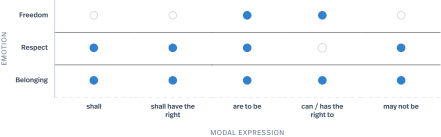
The modal structures used with the keyword “ethnic” in constitutional articles generally express emotions such as freedom, belonging, and respect.
Syntactic analysis of the term “ethnic”
The term “ethnic” in constitutional texts goes beyond being a mere descriptive element; within its syntactic context, it carries multiple emotional and ideological layers of meaning.
Use in subject position
When the term “ethnic” is used in the subject position, it frames ethnic groups as entities integrated into the state’s system of values.
Austria, Article 8: “…preservation of these ethnic groups are to be respected, safeguarded and to be supported.” (Constitution of Austria, 2013)
→ In this usage, “ethnic” is portrayed as an element that must be protected.
Use in object position
Although the word ethnic is most commonly used as an adjective, there are contexts within constitutional texts and official documents where it appears in syntactic object position. In particular, expressions such as ethnic group, ethnic identity, or ethnic origin function as objects when they become the direct target of a right, a form of state intervention, or a regulatory act.
Hungary – Article IX: “The right to freedom of speech may not be exercised with the aim of violating the dignity of the Hungarian nation or of any national, ethnic, racial or religious community.” (Constitution of Hungary, 2016)
→ In this usage, ethnic is portrayed as something that must be protected and granted freedom.
Use in predicate surroundings
When the term ethnic is used in the area surrounding the predicate, it serves to transfer freedom or protection to a defined group. This syntactic structure is often associated with an egalitarian and recognition-based emotional tone.
Poland, Article 35: “Polish citizens belonging to national or ethnic minorities the freedom…” (Constitution of Poland, 2009)
→ In this context, ethnic again signifies a group whose rights must be protected and respected.
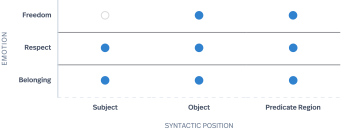
In subject position, the emotions of belonging and respect come to the forefront; in object position, belonging, freedom, and respect are emphasized; and in predicate surroundings, the dominant emotions are also belonging, freedom, and respect.
Discourse intent-based analysis of the term “ethnic”
In constitutional, legal, media, and political discourses, the term ethnic is often used as a descriptor referring to a group’s cultural, biological, or social difference. However, this descriptiveness is rarely neutral; through its linguistic form, it often marks, defines, or marginalizes a group as outside the norm.
Protective discourse refers to linguistic constructions in constitutions or official documents that aim to guarantee the existence, rights, cultural continuity, or dignity of a specific group (e.g., ethnic minorities).
Lithuania – Article 37: “Citizens belonging to ethnic communities shall have the right to foster their language, culture, and customs.” (Constitution of Lithuania, 2019)
→ This emphasizes the protection of ethnic identity through cultural elements.
Inclusive discourse is a type of constitutional language that affirms equal rights for individuals regardless of language, ethnic origin, or minority status. It seeks to prevent discrimination and aims to include all segments of society legally and symbolically.
Sweden – Article 2: “The public institutions shall promote the opportunity for all to attain participation and equality.” (Constitution of Sweden, 2012)
→ The state’s duty is to create equal opportunities for participation without discrimination among individuals.
Representative discourse in constitutional texts goes beyond merely recognizing ethnic, cultural, or minority groups; it seeks to ensure their direct representation at political, institutional, or symbolic levels.
Hungary – Article 16: “A deputy shall be responsible for the protection of the rights of nationalities.” (Constitution of Hungary, 2016)
→ The state appoints an institutional representative responsible for protecting minority rights. However, this representative operates under central government authority and is not fully independent.
| Emotion | Discourse Type | |||
|---|---|---|---|---|
| Inclusion | Exclusion | Representation | Protective | |
| Nostalgia | Hungary, Romania, Lithuania | |||
| Disgust | Germany, Sweden, Poland, Romania, Bulgaria, Serbia, Belgium | Bulgaria, Bosnia-Herzegovina | Austria, Sweden, Hungary, Romania, Bulgaria, Portugal, Lithuania | |
| Respect | Germany, Sweden, Poland, Romania, Bulgaria, Serbia, Belgium | Austria, Sweden, Hungary, Romania, Bulgaria, Portugal, Lithuania | ||
| Freedom | Germany, Sweden, Poland, Romania, Bulgaria, Serbia, Belgium | Austria, Sweden, Hungary, Romania, Bulgaria, Portugal, Lithuania | ||
| Joy | Germany, Sweden, Poland, Romania, Bulgaria, Serbia, Belgium | |||
Analysis of the keyword “language”
The keyword “language”, extracted from constitutional texts, has been subjected to a multi-layered analysis within the framework of its syntactic position, modality structure, and discursive intent.
Analysis of the word “language” according to modality
“Shall”: This modal form is typically used to express constitutional obligations related to the preservation, formalization, or recognition of a language. The emotional tone generally emphasizes respect and belonging.
Poland – Article 27: “Polish shall be the official language of the Republic of Poland...” (Constitution of Poland, 2009)
→ Here, formality and a sense of national unity are emphasized. Language is framed as the foundation of national identity.
→ Emotion: Belonging, Respect, Freedom
Hungary – Article H: “Hungary shall protect Hungarian Sign Language...” (Constitution of Hungary, 2016)
→ This article highlights feelings of cultural protection and identity. Language is preserved as a part of cultural integrity.
→ Emotion: Belonging
Portugal – Article 9(f): “The state shall promote the use and international diffusion of the Portuguese language.” (Constitution of Portugal, 2005)
→ This clause expresses a positive national responsibility through both inclusiveness and linguistic belonging.
→ Emotion: Belonging
“Shall not”/“is not permitted”: This modal structure is used especially to prevent discrimination and to guarantee individual rights. The emotional tone generally centers on respect.
Germany – Article 3: “No person shall be favoured or disfavoured because of language...” (Constitution of Germany, 2014)
→ This clause prohibits language-based discrimination. It centers on equality and inclusivity.
→ Emotion: Belonging, Respect
“May”: This modal often indicates that local governments or individuals may exercise certain language preferences. Emotionally, it conveys pluralism and a soft sense of inclusiveness.
Sweden – Article 12: “No speaker may use personally insulting language...” (Constitution of Sweden, 2012)
→ This expression supports a structure that maintains respect and social order. The constitution establishes a restorative tone for public communication.
→ Emotion: Belonging, Respect
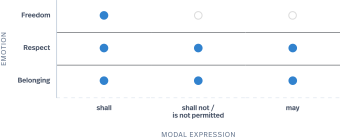
The modal “shall” is the most commonly used form and is associated with emotions such as respect and belonging. This indicates that linguistic rights are strongly safeguarded in constitutional articles and that the state assumes an active role in this regard. The structure “shall not / is not permitted” is particularly linked to belonging and respect. This usage reflects the state's intention to avoid restricting citizens' rights and to prohibit interference in certain areas. The modal “may” is more flexible and reflects choices left to the individual, which typically aligns with the emotions of belonging and respect.
Syntactic analysis of the term “language”
In constitutional texts, the word language goes beyond being a mere descriptive element and carries multiple emotional and ideological layers depending on its syntactic context.
Use in subject position
When used in the subject position within constitutional or legal texts, the term language implies meanings of representation and autonomy.
Germany – Article 8(2): “Language and culture, existence and preservation of these ethnic groups are to be respected, safeguarded and to be supported.” (Constitution of Germany, 2014)
→ In this context, language is framed as a cultural value that must be protected.
Use in object position
Language appears in the object position when it is the direct target of an action. This is typically related to rights, protection, or regulation.
Portugal – Article 9(f): “…to protect and promote the use of the Portuguese language…” (Constitution of Portugal, 2005)
→ Here, “the Portuguese language” functions as the direct object that is to be protected and promoted. The constitution positions language as a value to be preserved.
Use in predicate surroundings
When the term language is used around the predicate, it usually appears in contexts related to judicial proceedings, education, or public services, functioning as a regulatory element of system operation.
Italy (Article 111): “…shall have the right to a translator if trial is conducted in a language not understood…” (Constitution of Italy, 2020)
→ “In a language not understood” functions within the predicate. In this case, language is seen as a component of fair legal process.
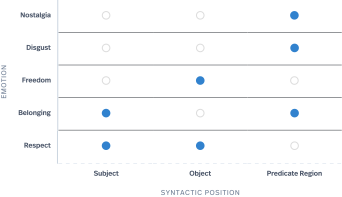
In subject position, the emotions of belonging and respect come to the forefront; in object position, freedom and respect are emphasized; and in predicate surroundings, the dominant emotions are belonging, disgust, and nostalgia.
Discourse intent-based analysis of the term “language”
Constitutional provisions containing the keyword “language” were examined based on their discourse intent. The analysis revealed that the articles featuring language predominantly reflect inclusive, protective, representative, and controlling discourse characteristics. In inclusive discourse, language is associated with cultural continuity and the inclusion of different groups.
Norway – Article 108: “It is the responsibility of the authorities of the State to create conditions enabling the Sami people to preserve and develop their language...” (Constitution of Norway, 2016)
→ Language is promoted as a means to preserve the cultural continuity of ethnic groups. This reflects the recognition of belonging at the constitutional level.
In protective discourse, language is framed in terms of preserving linguistic integrity.
Greece – Article 3: “Any translation of the Holy Scripture shall be made only with approval...” (Constitution of Greece, 2008)
→ Linguistic integrity is protected solely in the context of sacred texts, indicating a form of religious and cultural purity enforced through state authority.
In representative discourse, language fosters a sense of pluralistic belonging.
Poland – Article 27: “Polish shall be the official language of the Republic of Poland, but this provision shall not infringe upon the rights of national minorities...” (Constitution of Poland, 2009)
→ While the official language is recognized, minority rights are also constitutionally guaranteed, creating a sense of pluralistic inclusion.
In controlling discourse, language serves the logic of authority.
Lithuania – Article 117: “Court hearings shall be conducted in the State language.” (Constitution of Lithuania, 2019)
→ The emphasis on the official language is applied without consideration for individual needs, reflecting an authoritarian approach to language through the lens of citizenship.
These examples clearly demonstrate that language in constitutions functions both as a tool of communication and as a vehicle for emotional and symbolic representation, shaped by discourse type and its associated emotional tone.
| Emotion | Discourse Type | |||
|---|---|---|---|---|
| Inclusive | Protective | Representative | Controlling | |
| Nostalgia | Poland | |||
| Disgust | Greece | |||
| Freedom | Sweden | Netherlands | ||
| Interest | Romania | |||
| Respect | Italy | Germany | ||
| Belonging | Romania, Bosnia-Herzegovina | Sweden, Estonia | Hungary | |
Analysis of the keyword “identity”
The keyword “identity” extracted from constitutional texts, has been subjected to a multi-layered analysis within the framework of its syntactic position, modality structure, and discursive intent.
Analysis of the word “identity” according to modality
Shall/shall not: The modal shall is the most frequently used form of obligation in constitutional texts. It assigns a responsibility to the state or institution. The structures shall not / is not permitted carry a restrictive, protective tone, often relating to the safeguarding of privacy or rights.
Hungary, Article D: “It shall support their efforts to preserve their Hungarian identity.” (Constitution of Hungary, 2016)
→ The expression shall support places responsibility on the state to protect the identity of the Hungarian diaspora. The discourse is both supportive and emphasizes national belonging.
→ Emotion: Freedom, Belonging, Respect
Sweden, Article 2: “It shall not be permitted to inquire into the identity of an author.” (Constitution of Sweden, 2012)
→ Public authorities are prohibited from investigating the identity of press sources. This aligns with the principles of freedom of expression and anonymity.
→ Emotion: Freedom, Respect
May be: This modal structure expresses that an action may occur conditionally or under exception. It indicates permission rather than obligation.
Sweden, Article 4: “No public authority or other public body may inquire into the identity of the author of material inserted, or intended for insertion, in printed matter, a person who has published, or who intends to publish, material in such matter, or a person who has communicated information under Chapter 1, Article 1, paragraph three, except insofar as this is necessary for the purpose of such prosecution or other action against him or her as is not contrary to the provisions of this Act.” (Constitution of Sweden, 2012)
→ Although the phrase may be is not explicitly used, the modal may inquire into indicates that inquiring into the author’s identity is generally prohibited, except in narrowly defined legal circumstances.
→ This usage frames identity as protected, untouchable, and confidential.
→ Emotion: Freedom, Respect
Is to / Are: This modal is used in some legal texts in a technical sense, usually to describe legal definitions or procedural requirements.
Austria, Article 26(6): “The identity of the applicant is to be proven prima facie.” (Constitution of Austria, 2013)
→ This structure indicates that verifying one’s identity is a mandatory procedural step. It is a technical yet binding expression.
→ Emotion: Respect
Shall contain: This structure signals an institutional requirement or directive.
Spain, Article 147: “The Statutes of Autonomy must contain: The name of the Community which best corresponds to its historic identity.” (Constitution of Spain, 2011)
→ This clause requires that regional statutes include a name aligned with their historical identity, emphasizing the importance of identity in institutional representation.
→ Emotion: Belonging, Respect
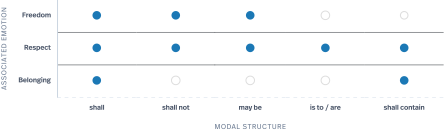
The structure “shall” is the most frequently used obligation modal in constitutional documents. It signifies that the state assumes an active role in recognizing, protecting, or promoting identity. This form not only reinforces a relationship of mutual respect between the citizen and the state but also evokes a sense of belonging, especially in contexts involving diaspora or minority identities.
The structure “shall not” introduces a discourse that protects the privacy of individual identity. It constitutionally prohibits public authorities from investigating or disclosing one’s identity. In doing so, it safeguards personal freedom while limiting the sense of discomfort or disgust that might arise from excessive state intrusion. Simultaneously, it conveys respect for the individual's identity.
The modal “may” generally refers to exceptional circumstances or voluntary actions. Identity may be disclosed only under specific conditions. This reflects a constitutional balance between ethical principles and state interest. The state does not directly interfere with the individual but shows concern and respect for their situation.
The form “is to / are” is more procedural and descriptive. It is commonly used to specify processes such as how identity is to be verified. Although emotionally neutral, it foregrounds procedural respect and institutional order in matters related to identity confirmation. The construction “shall contain” is typically used in contexts of regional autonomy or historical identity. It mandates the formal recognition of such identities within institutional documents.
Syntactic analysis of the term “identity”
In constitutional texts, the term identity carries emotional and ideological layers beyond its semantic function. Therefore, analyzing the syntactic position of identity – and its relationship to affective meaning – offers a critical tool for revealing the emotional dynamics embedded in constitutional discourse.
Use in subject position
When identity appears in the subject position, it is framed as an element that must be protected. Such constructions evoke emotions such as interest, respect, freedom, belonging, and nostalgia.
Austria – Article 26(6): “The identity of the applicant is to be proven prima facie.” (Constitution of Austria, 2013)
→ Here, identity is in the subject position. Its role as the subject, rather than the object of verification, highlights a process centered more on the state than on the individual’s active participation.
Use in object position
When identity functions as an object, it is the target of the verb—either being acted upon, protected, or regulated.
Sweden – Article 14: “No public authority is permitted to inquire into a person’s identity.” (Constitution of Sweden, 2012)
→ In this example, identity is in the object position and is protected from inquiry. It is treated as a private entity, shielded from state intervention. This evokes emotions such as freedom and protection, reinforcing the individual’s autonomy.
Poland – Article 35: “Protect religious identity… cultural identity” (Constitution of Poland, 2009)
→ Here, identity is directly in the object position. These identities are defined as entities that the state has a duty to actively protect.
Use in predicate surroundings
When identity appears in predicate-adjacent constructions, it often contributes to clauses about identity assessment or symbolic meaning.
Poland – Article 6: “Cultural goods which are the source of the Nation’s identity.” (Constitution of Poland, 2009)
→ Identity functions within a possessive construction and is not directly linked to the verb, yet it plays a descriptive role. It signifies belonging and historical continuity.
Hungary – Article D: “It shall support their efforts to preserve their Hungarian identity.” (Constitution of Hungary, 2016)
→ Here, identity appears in a predicate-surrounding, indirect object position. It is framed as a national value that must be protected.
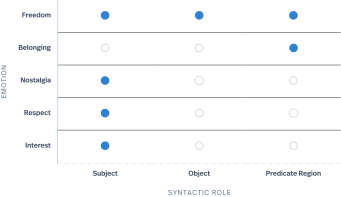
Uses of identity in the subject position predominantly evoke emotions such as respect, belonging, nostalgia, and freedom. This stems from the framing of identity as an independent and valuable entity worthy of protection. When identity is used in the object position, it primarily triggers a sense of freedom, while in predicate-surrounding or indirect positions, it tends to evoke feelings of belonging or freedom.
Discourse intent-based analysis of the term “identity”
Constitutional provisions containing the keyword identity have been analyzed in terms of their discourse intent. The analysis reveals that such articles generally exhibit inclusive, protective, representational, and controlling discourse orientations. Inclusive discourse intent supports the individual’s right to express their identity.
Romania – Constitution, Article 6: “The State recognizes and guarantees the right to express ethnic, cultural, linguistic and religious identity.” (Constitution of Romania, 2003)
→ The state encourages individuals to express their identity rather than conceal it.
Protective discourse intent involves language aimed at safeguarding the individual.
Portugal – Constitution, Article 19(6): “Identity shall be protected even in emergencies. (Constitution of Portugal, 2005)
→ The state is expected to refrain from interfering with personal identity even under extraordinary circumstances.
Sweden – Constitution, Article 14: “No public authority is permitted to inquire into a person’s identity.” (Constitution of Sweden, 2012)
→ This reflects a constitutional commitment to protecting the privacy of individual identity.
Representational discourse intent entails the recognition of identity within official institutions.
Spain – Constitution, Article 147: “The Statutes shall contain the name most fitting to its historical identity.” (Constitution of Spain, 2011)
→ The state ensures that regional or national identities are preserved in institutional documents.
Poland – Constitution, Article 6: “Cultural goods which are the source of the Nation’s identity shall be protected.” (Constitution of Poland, 2009)
→ Identity is linked to the continuity of national culture.
Controlling discourse intent includes statements oriented toward ensuring individual security.
Austria – Constitution, Article 26(6): “The identity of the applicant is to be proven prima facie.” (Constitution of Austria, 2013)
→ Individuals are required to disclose their identity in the interest of system security.
Netherlands – Constitution, Article 12: “Prior identification and notice of purpose shall be required in order to enter a home.” (Constitution of the Netherlands, 2008)
→ Identity disclosure is mandated as a prerequisite for state action, reflecting a security-oriented discourse.
| Emotion | Discourse Type | |||
|---|---|---|---|---|
| Inclusive | Protective | Representative | Controlling | |
| Nostalgia | Spain, Poland | |||
| Disgust | Sweden | Germany | ||
| Freedom | Romania, Belgium | Sweden, Portugal | Austria, Netherlands, Germany | |
| Interest | ||||
| Respect | Romania | Estonia, Sweden | ||
| Belonging | Germany, Italy, Bosnia, Bulgaria | Estonia, Sweden, Portugal, Greece | Hungary, Spain, Lithuania | |
This heatmap illustrates how the concept of “identity” is associated with different emotions and discourse intents in European constitutional discourse. It shows that in identity-related constitutional articles:
The feeling of belonging is most prominently expressed through inclusive and representational discourse;
The emotion of freedom is primarily conveyed through protective and controlling discourse;
And respect appears predominantly within protective discourse.
These findings reveal that constitutional narratives of identity are structured both emotionally and ideologically in distinct ways across different countries.
Analysis of the keyword “culture”
The keyword “culture”, extracted from constitutional texts, has been subjected to a multi-layered analysis within the framework of its syntactic position, modality structure, and discursive intent.
Analysis of the word “culture” according to modality
In constitutional texts, the modal structures used in expressions containing the word culture not only indicate the necessity of an action but also reveal the underlying intent and emotional tone of that action. Modal markers such as shall, must, may, can, and is prohibited provide insights into the rigidity or flexibility of constitutional regulations. The emotions associated with each modal vary depending on the structure used in the sentence containing culture.
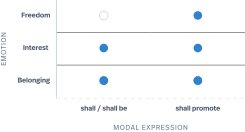
“Shall/shall be”: This modal indicates that the state or constitutional authority assumes an active and binding responsibility regarding culture. Such expressions are usually placed in a positive and encouraging context.
Sweden, Article 2: “The personal, economic and cultural welfare of the individual shall be fundamental aims of public activity.” (Constitution of Sweden, 2012)
→ The phrase shall be indicates that individual well-being must necessarily be a central objective of public activity.
→ Emotion: Interest, Belonging
“Shall promote”: This modal shows that access to culture is constitutionally guaranteed.
Spain, Section 47: “The public authorities shall promote conditions for the free and effective participation of young people in political, social, economic and cultural development.” (Constitution of Spain, 2011)
→ Emotion: Freedom, Interest, Belonging
Syntactic analysis of the term “culture”
In constitutional texts, the word culture carries emotional and ideological layers beyond its semantic function, depending on its syntactic context. The position of the word in a sentence—whether subject, object, or indirect complement—directly influences its perceived value and discursive function. Therefore, the relationship between the syntactic position of culture and its emotional connotations provides a critical lens for revealing the ideological mechanisms of constitutional language.
Use in subject position
When culture appears in the subject position, it is framed as the voice of a collective identity with influence over society. Such structures tend to evoke emotions such as interest, respect, freedom, belonging, and nostalgia.
Lithuania – Constitution, Article 42: “Culture, science and research, and teaching shall be free.” (Constitution of Lithuania, 2019)
Use in object position
When culture functions as an object, it is typically positioned as a domain to be promoted, supported, or regulated. These structures focus on the action of a constitutional actor (usually the state) and tend to evoke more interactive emotions such as:
joy (encouraging discourse);
interest (development-oriented direction); and
indirectly, freedom (the right of individuals to participate in leisure and cultural activities).
Netherlands – Constitution, Article 22: “The authorities shall promote social and cultural development and leisure activities.” (Constitution of the Netherlands, 2008)
→ In this sentence, culture functions adjectivally within cultural development, which is the direct object of the verb shall promote. Thus, culture is situated near the object position and functions as the target of state action.
In this context, culture is positioned not only as a normative domain but also as a narrative object that promotes individual development and social well-being.
Use in predicate surroundings
In some constitutional expressions, culture appears in an indirect complement or as part of a compound expression. These constructions often reflect protective or restrictive approaches.
Sweden – Constitution, Article 2: “No one shall in his or her relations with the public institutions be coerced to divulge an opinion in a political, religious, cultural or other such connection.” (Constitution of Sweden, 2012)
→ Here, culture is used within a contextual frame and not as a grammatical argument of the verb. It serves as a ground for rights and protections.
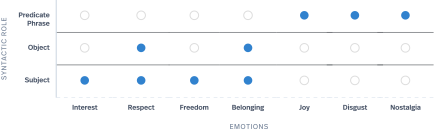
Uses of culture in the subject position predominantly evoke emotions such as respect and belonging. This stems from framing culture as an independent and worthy entity that deserves protection. When used in the object position, culture tends to generate more active and participatory emotions such as freedom, interest, and respect. In predicate-surrounding or indirect positions, more context-sensitive emotions such as joy, disgust, or nostalgia are often triggered.
Discourse intent-based analysis of the term “culture”
Constitutional provisions containing the keyword culture have been analyzed based on discourse intent. The analysis reveals that articles featuring the term culture generally reflect inclusive and protective discourse orientations.
| Emotion | Discourse Type | |
|---|---|---|
| Inclusive | Protective | |
| Freedom | Germany, France, Sweden, Romania, Spain | Estonia |
| Joy | Netherlands, Hungary | |
| Respect | Austria | |
| Belonging | Bulgaria, Lithuania, Bosnia-Herzegovina | Norway, Poland, Italy, Portugal |
This matrix chart illustrates how emotional expressions (such as freedom, belonging, joy, and respect) in the constitutional texts of European countries are presented through particular discourse intents (whether inclusive or protective), and how these structures are distributed across countries. The combination of freedom + inclusive discourse is the most common, observed in countries such as Germany, France, Sweden, Romania, and Spain.
The emotion of belonging appears in both inclusive (e.g., Lithuania, Bosnia & Herzegovina, Bulgaria) and protective (e.g., Norway, Poland, Italy, Portugal) discourse intents, reflecting a multifaceted constitutional approach. Joy is associated only with inclusive discourse and is found in the constitutions of the Netherlands and Hungary, suggesting that positive emotions are typically aligned with inclusive policies. Respect appears exclusively in Austria and only within a protective framework, indicating a more traditional and conservative stance. The freedom + protective combination is uniquely represented by Estonia.
Analysis of the keyword “minority”
The keyword “minority”, extracted from constitutional texts, has been subjected to a multi-layered analysis within the framework of its syntactic position, modality structure, and discursive intent.
Analysis of the word “minority” according to modality
The use of modals such as shall in constitutional and international legal documents in conjunction with the term minority signifies the state’s clear and binding responsibilities regarding minority rights. These modal structures frame the protection of minorities not merely as an ideal but as a normative requirement. In this context, the use of obligation modals reflects the state’s ideological stance toward pluralism.
Lithuania – Constitution, Article 37: “Citizens belonging to ethnic communities shall have the right to foster their language, culture, and customs.” (Constitution of Lithuania, 2019)
→ shall have the right → obligation→ Emotion: Freedom, Belonging, Respect
Serbia – Constitution, Article 77: “Members of national minorities shall have the right to participate in administering public affairs and assume public positions, under the same conditions as other citizens.” (Constitution of Serbia, 2006)
→ shall have the right → obligation→ Emotion: Freedom, Belonging, Respect
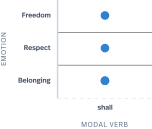
The modal “shall” is associated with four core emotions: freedom, belonging, and respect. This intensity demonstrates that shall is dominant in the discourse on minority rights and allows for multi-layered emotional representation. Constructions such as “shall preserve” and “shall recognize” emphasize the constitutional duty to protect and include minorities.
The frequent use of shall in minority-related provisions suggests that the state carries a strong sense of inclusiveness and responsibility toward these groups. Phrases like “shall preserve minority languages” or “shall support minority groups” indicate that the cultural identities of minorities are constitutionally safeguarded and that this protection is framed as an active obligation.
Syntactic analysis of the term “minority”
In constitutional texts, the term minority carries emotional and ideological layers beyond its descriptive function, depending on its syntactic placement. Whether it appears as subject, object, or within predicate surroundings, its position shapes the values and discursive roles attributed to it. Thus, the relationship between the syntactic position of minority and its emotional connotations offers crucial insight into how constitutional language frames minority identities and the ideological foundations underlying this framing.
Use in subject position
When minority appears in the subject position in constitutional and legal texts, it is framed as referring to individuals capable of exercising their rights.
Romania – Article 128: “Romanian citizens belonging to national minorities have the right to express themselves in their native language before the courts of law, in the terms defined by the organic law.” (Constitution of Romania, 2003)
→ Here, national minorities is part of the subject. Minorities are not only the object of a provision but also active rights holders and agents. Such sentences position minorities as actors, attributing to them the role of active constitutional citizens.
Use in object position
When minority is placed in the object position, its role goes beyond language structure and takes on strong ideological and emotional meaning. In this position, minority becomes the target of. an action defined by the majority.
Italy – Article 6: “The Republic safeguards linguistic minorities by means of appropriate measures.” (Constitution of Italy, 2020)
→ In this sentence, linguistic minorities serves as the direct object of the verb safeguards. Minorities are passively subjected to protective actions. The framing defines minorities not as agents but as recipients of state intervention.
Use in predicate surroundings
Belgium – Article 11: “Enjoyment of the rights and freedoms recognised for Belgians must be provided without discrimination. To this end, laws and federate laws guarantee among others the rights and freedoms of ideological and philosophical minorities.” (Constitution of Belgium, 2014)
Here, the phrase ideological and philosophical minorities includes minorities as a noun and the modifiers as adjectives. Although grammatically a noun phrase, within the sentence it functions more as a categorical framework for rights, not as a subject or direct object. In this way, minorities are framed as a context, not as actors.
Bosnia and Herzegovina – Article 7: “No person shall be deprived of Bosnia and Herzegovina or Entity citizenship on any ground such as sex, race, color, language, religion, political or other opinion, national or social origin, association with a national minority, property, birth or other status.”
(Constitution of Bosnia and Herzegovina, 2009)
In this example, minority appears in connection to a social identity. It is not a grammatical subject but forms part of the rationale for legal protection.
Across constitutional texts, the term minority is most often:
Used in the object position, as the passive recipient of actions such as protection, recognition, or support;
Less frequently used in the subject position, where minorities are framed as active rights claimants;
Commonly found within qualifying or descriptive structures, where the concept is defined but not assigned agency.
These syntactic patterns reveal that minorities are often portrayed in constitutional discourse as passive, regulated subjects. This highlights that legal language is not only descriptive but also a performative force that shapes representation.
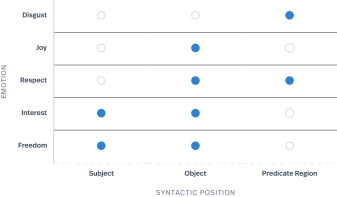
When the word minority appears in the subject position, it most frequently triggers the emotion of freedom. Presenting minorities as agents in constitutional discourse reflects a liberal and participatory form of representation. It is also occasionally associated with the emotion of interest, which emerges in contexts implying that the state is attentive to the needs of minority groups.
When minority appears in the object position, the emotional range becomes more diverse. This syntactic structure may carry a protective and supportive tone (interest, respect), a liberating tone (freedom), or even a celebratory one (joy). This suggests that constitutional discourse, even when portraying minorities passively, tends to center positive actions directed toward them.
When minority occurs in the predicate surroundings, the emotional orientation of the constitutional act becomes much sharper: it may emphasize respectful protection, or alternatively, involve verbs that imply rejection or exclusion. This demonstrates that the nature of the predicate directly shapes the emotional tone. Compared to other syntactic positions, this one tends to exhibit more polarized (positive/negative) emotional expressions.
Discourse intent-based analysis of the word “minority”
Articles in constitutions have been examined based on the keyword minority in terms of discourse intent. The analysis shows that clauses containing the keyword minority typically exhibit inclusive, protective, and representative discourse characteristics.
In inclusive discourse, minorities are viewed as equal members of society; their rights, cultural identities, and opportunities for participation are constitutionally guaranteed.
Romania – Article 6: “The state recognizes and guarantees for members of the national minorities the right to preserve, develop, and express their ethnic, cultural, linguistic, and religious identity.” (Constitution of Romania, 2003)
→ This statement acknowledges the multifaceted identity of minorities and elevates it to a constitutional level through an inclusive state approach.
Estonia – Article 37: “Everyone has the right to receive instruction in Estonian. The language of instruction in national minority educational institutions shall be chosen by the educational institution.” (Constitution of Estonia, 2015)
→ The state encourages linguistic inclusivity by recognizing minority languages in education.
In the protective discourse approach, minorities are framed as vulnerable groups in need of safeguarding. Constitutional language here often includes verbs like “to take measures” or “to ensure protection.”
Italy – Article 6: “The Republic safeguards linguistic minorities by means of appropriate measures.” (Constitution of Italy, 2020)
→ The Republic commits to protecting linguistic minorities through appropriate interventions.
The representative discourse approach emphasizes the visibility of minorities in the political system and their inclusion in decision-making processes, often through electoral systems and parliamentary structures.
Romania – Article 62(2): “Citizens of an ethnic minority may be represented by only one organization.”
→ The constitution guarantees the parliamentary representation of minorities. (Constitution of Romania, 2003)
| Emotion | Discourse Type | ||
|---|---|---|---|
| Inclusive | Protective | Representative | |
| Joy | Portugal | ||
| Respect | Romania | Italy, Bosnia-Herzegovina, Estonia | |
| Freedom | Romania, Estonia | ||
| Interest | |||
| Belonging | Romania, Belgium | Romania, Italy | |
This chart demonstrates that constitutional texts contain not only legal but also emotionally and ideologically driven discourse.
Inclusive discourse tends to produce a warmer and more diverse emotional range.
Protective discourse leans toward limited and defensive emotions.
Representative discourse fosters emotions related to active citizenship and democratic participation.
In this study, the term “minority” in European constitutions has been analyzed through a multilayered linguistic approach. Discourse-level classifications reveal that minorities are framed through three main discourse intents in constitutional language: inclusive, protective, and representative. Each of these discourses is associated with distinct emotional tones. For instance, inclusive discourses tend to evoke emotions of freedom and interest, while protective ones carry a tone rooted in respect and safeguarding.
Discussion
The findings obtained in this study prove that constitutional texts are not just rational legal norms, but also “affective construction zones” that shape social identities. Analyses conducted in light of the modality theories of von Wright (1951) and Nauze (2008) have shown that structures denoting obligation, such as “shall” and “is to,” are not merely “commands” in the constitution, but are also tools that construct “respect” and “trust” at the highest level. This situation reveals that constitutional duties seal loyalty to the social contract on an emotional foundation.
The direct pairing of articles where concepts are in the “subject” position with the feeling of “freedom” shows parallelism with Nuyts’ (2006) concept of “dynamic modality.” This is the most concrete evidence that the constitutional legislator makes a grammatical choice to construct identities as “active subjects of rights.” Conversely, the pairing of the concepts “ethnic” and “culture” in the “object” position with “belonging” has been evaluated as a reflection of the state's protective will.
The appearance of the “disgust/aversion” feeling in both protective and exclusionary discourses reflects the “defensive” character of the constitution. This data semantically documents the "legal distance" the text develops against specific violations and threats.
Conclusion
Modal categories trigger specific emotional meanings with varying intensities. As seen in Table 9, the forms “shall” and “is to/are” are the primary mechanisms that maintain the feeling of respect at the highest level in constitutional texts. This proves that constitutional duties are not merely technical obligations but are built upon an ethical foundation of respect. The concept of “ethnic” emerged as the term with the widest modal diversity in the study, pairing with five different modal structures (shall, shall have the right, are to be, can, may not be). This situation demonstrates that ethnic identity is constructed in constitutions along a multidimensional emotional line of tension, balancing both “recognition of rights” and “limitation.”
It was found that the concept of “culture” reinforces the feeling of belonging by combining with softer and more supportive modals (shall promote); in contrast, the concept of “minority” is confined to the state’s domain of “duty” by being expressed only with “shall,” which denotes absolute obligation.
While the feeling of respect maintains its presence across almost all modal structures, reflecting the universal foundation of the constitution based on human dignity, the distribution of emotions such as Freedom and Belonging varies in parallel with the autonomy granted to groups or the responsibility imposed upon them by the legislator.
| Modal category | Modal forms | Respect | Freedom | Belonging | Interest |
|---|---|---|---|---|---|
| Obligation | shall, is to/are | High | Medium | Medium | None |
| Prohibition | shall not, not permitted | Medium | Low | Low | None |
| Right | shall have the right, can | Low | High | Medium | None |
| Permission | may | Low | Medium | Low | None |
| Possibility | may be | Low | Low | Medium | High |
| Promotion | shall promote | Low | Low | High | Medium |
The syntactic findings of the research have shown that the position of concepts within the sentence hierarchy of constitutional articles is not coincidental; on the contrary, it constructs a specific emotional status. It has been established that in structures where the concepts of “language,” “identity,” and “minority” are in the subject position, these concepts are directly sealed with the emotions of Freedom and Interest. This situation proves that the constitutional legislator transforms these identities from passive elements into active subjects of rights capable of self-determination.
In cases where concepts such as “ethnic” and “culture” are in the object position, it has been observed that the emotions of belonging and respect become dominant. These data document that “objectification” in a legal context is not always a negative situation; rather, it points to the status of a “valuable asset” that must be preserved and is subject to the state's will to protect.
In instances where words are positioned in the predicate region, it has been determined that more complex emotions such as disgust and nostalgia emerge. Specifically, the “disgust” value identified for “culture” and “language” has been interpreted as a “legal distance” and “rejection” that the constitution establishes against the violation or assimilation of these values. The data demonstrate that it is not only important “what” constitutions say, but also within which syntactic sequence they construct this discourse.
| Keyword | Syntactic position | Affective language (assigned emotion) |
|---|---|---|
| Ethnic | Subject | Respect, Belonging |
| Object | Belonging, Respect, Freedom | |
| Predicate Region | Belonging, Respect, Freedom | |
| Language | Subject | Respect, Belonging |
| Object | Respect, Freedom | |
| Predicate Region | Nostalgia, Disgust, Belonging | |
| Identity | Subject | Nostalgia, Respect, Interest, Freedom |
| Object | Freedom | |
| Predicate Region | Freedom, Belonging | |
| Culture | Subject | Interest, Respect, Freedom, Belonging |
| Object | Respect, Belonging | |
| Predicate Region | Joy, Disgust, Nostalgia | |
| Minority | Subject | Freedom, Interest |
| Object | Joy, Respect | |
| Predicate Region | Disgust, Respect |
The discursive intent with which constitutional texts present key concepts directly determines the emotional weight of these concepts in social perception. As a result of the analyses conducted, the following primary strategies have been identified:
It has been observed that “inclusive” and “representative” discourses consistently trigger feelings of belonging, joy, and respect across all concepts (ethnic, language, ıdentity, culture, minority). These data prove that in cases where the constitution recognizes identities as essential parts of the system, the text goes beyond being a “social contract” and constructs a positive emotional foundation.
It has been found that “protective” discourse brings about feelings of disgust alongside respect and freedom. The “disgust” value here reflects the constitutio’s will to avoid the assimilation or violation of the value it protects; in other words, it reflects a legal “defense reflex.”
It is noteworthy that nostalgia and disgust values come to the fore in articles where “control” and “exclusionary” intents are dominant. Specifically, the nostalgia identified for “identity” and “language” seals the fact that the constitution uses a conservative reference point based on the past when regulating these areas, while “disgust” seals the intent to exclude undesirable situations.
| Keyword | Discourse intent | Affective language (assigned emotion) |
|---|---|---|
| Ethnic | Inclusive | Joy, Freedom, Respect, Disgust |
| Protective | Freedom, Respect, Disgust | |
| Exclusionary | Disgust | |
| Representative | Nostalgia | |
| Language | Inclusive | Belonging, Respect |
| Protective | Belonging, Freedom, Disgust | |
| Representative | Belonging, Nostalgia | |
| Controlling | Respect, Freedom | |
| Identity | Inclusive | Belonging, Respect, Interest |
| Protective | Belonging, Respect, Freedom, Disgust | |
| Representative | Belonging, Nostalgia | |
| Controlling | Freedom, Nostalgia | |
| Culture | Inclusive | Belonging, Joy, Respect, Freedom |
| Protective | Belonging, Respect, Freedom | |
| Minority | Inclusive | Belonging, Freedom, Respect |
| Protective | Respect | |
| Representative | Joy, Belonging |
Overall, this triple interaction between modality, syntax, and discursive intent transforms constitutional texts from static legal documents into emotional maps that govern a society's construction of identity. This study has established, through a scientific framework, that legal interpretation possesses not only literal and purposive dimensions but also an affective (emotional) dimension, which can be utilized as a fundamental criterion in measuring constitutional inclusivity.
Recommendations for future research
This study has opened a new door for “emotion semantics” in constitutional analysis and offers the following perspectives for future research. By applying the Multi-Layered Analysis Protocol used in this study to the texts of countries with different political traditions (e.g., liberal vs. conservative constitutions), the differences between “constitutional emotional maps” can be examined.
An analysis conducted through a country’s various historical constitutions (e.g., Turkey’s 1924, 1961, and 1982 constitutions) could reveal “emotional shifts” and “discursive transformations” in the state's perspective on social identities.
The manual coding process successfully implemented in this study could be supported by specialized Natural Language Processing (NLP) algorithms for larger datasets (corpora), allowing the “implicit emotional load” in constitutional texts to be mapped on a broader scale.
The real effects of this emotional construction in constitutional texts (e.g., the sense of belonging) on citizenship consciousness and constitutional loyalty could be brought to an interdisciplinary perspective by being supported with quantitative field research.
Ultimately, the “cold” language of the constitution actually offers a “warm” world of belonging, freedom, and trust to society through the subtle combination of syntax, modality, and discursive intent. This study has sealed, with a scientific matrix, the fact that the spirit of the law is hidden not only in the letters but in the architecture of the emotional language woven by those letters.